Wednesday, April 20, 2011

Aunt Anna's Easter grain pie


I know it's a little late in the game to be posting Easter recipes, but I just left Anna's place an hour ago. My aunt does not normally make her "grain pie" four whole days before the holiday, but she did so this time so that her "rotten nephew" could "take his pictures" for "that meatball thing he does."

Careful readers of this blog will know that I would like nothing more than to go on and on about my dear (and colorful) aunt. But time is getting short for those who are planning to bake during these next couple days, and so I will (sadly) get right to the recipe portion of our program.

Easter grain pie is one of only two dessert items on my Top 10 Foods of All Time list (sfogliatelle being the other). The pie's proper name is, well, that depends on whom you ask. The three most common are Pizza di Grano, Torta di Grano or Pastiera di Grano. It is, as best I can determine, a Neopolitan specialty, a notion that bears some weight, as Naples is where my family's roots run.

Like Pizza Rustica (aka "Easter meat pie"), Pizza di Grano is almost never made any time but around Easter. Only twice have I had it outside of this window, both times because I begged and pleaded to my dear friend Beth, Queen of the Bakers, to please, please, please devote a few hours of her busy life to making me one. (That is a troubling pattern I just now noticed, me cajoling women into baking fine pastries for me I mean. Hm.)

Perhaps we ought get to the demonstration. 


Anna's grain pie crust is among the thinnest I have witnessed. It is a fine crust, and here is its beginning. (The full recipe is below.) I asked her the reason behind her method of using room-temperature butter instead of ice cold butter and she smacked me across my head and told me to shut up. (Later she apologized and said that she just does, that's all. I made sure to be standing several feet away when broaching the subject this time.)
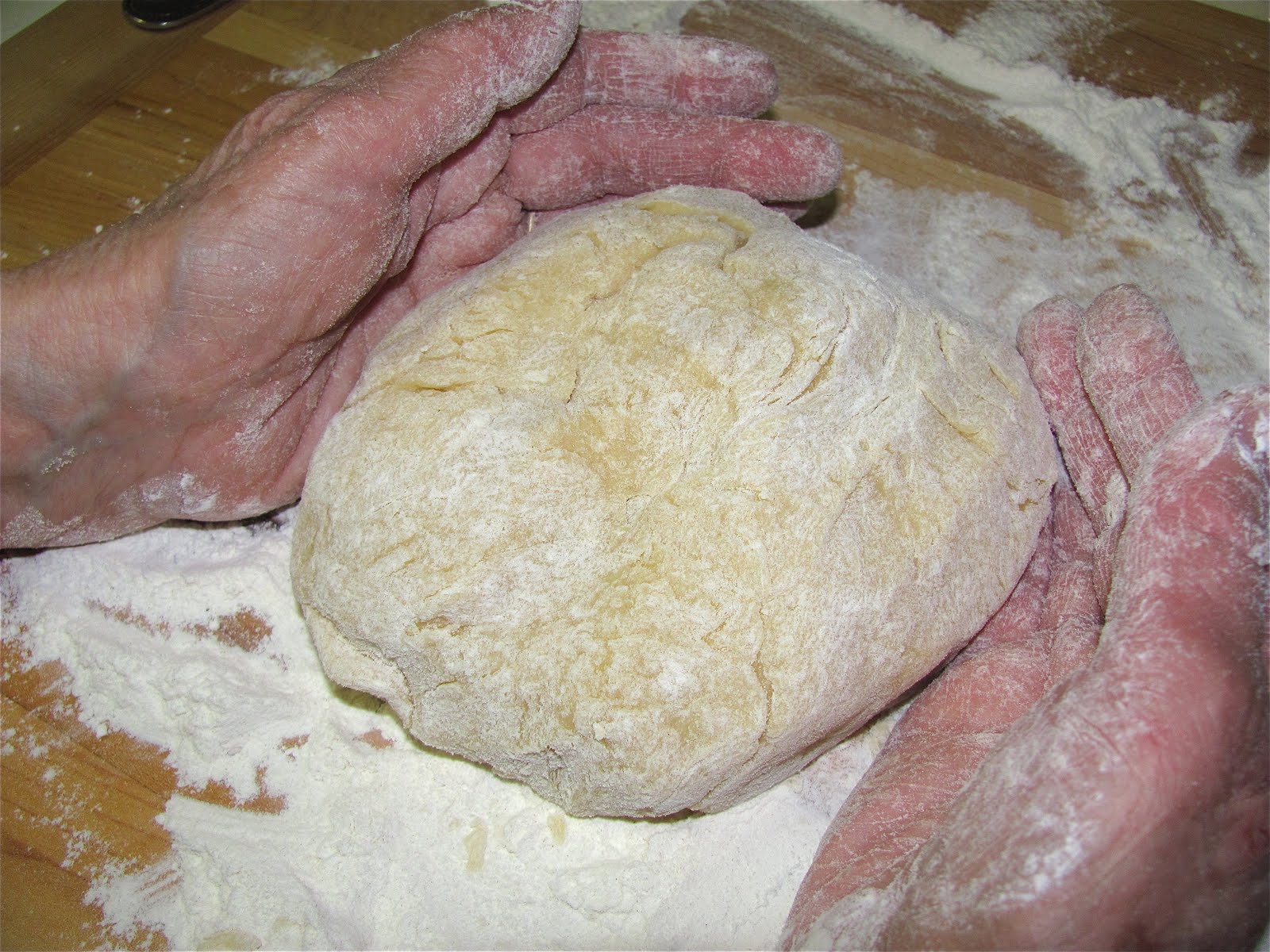

The only photograph of my aunt that she will allow me to use is this one. This is the finished dough she is caressing, in case you were wondering.


All rolled out and ready for the filling.


The filling, a mixture of cooked wheat berries, fresh ricotta cheese, eggs, sugar, pastry cream and orange zest.


That's the grain you see poking out of the filling. 


Before it goes into the oven the pie is topped with these cut strips of dough.


I've got prettier pictures of whole slices, but decided to go with this one instead.

A beautiful thing, no?


Easter Grain Pie (Pizza di Grano)
Recipe

For the crust
2 cups all-purpose flour
4 Tbsp sugar
1 stick sweet butter, softened
3 large eggs 
Pour flour out onto a work surface and create a circle in the center. Beat the eggs and sugar together in the circle, then add the butter and begin working into the flour until a ball forms. Allow to rest a few minutes, covered.
Divide into three equal parts, leaving enough dough to form cross strips on top of the pie. Roll the three pieces of dough so that each fits a 9-inch pie dish.

For the grain
1 1/4 cup wheat berries
Peel from one orange
1/4 cup sugar
Soak the grain in water overnight, then drain. In a fresh pot of water add the wheat berries and the orange peel and bring to a boil. Cook 20 to 30 minutes then drain and discard peel. While still warm mix in the sugar.

For the pastry cream
2 large eggs
2 large egg yolks
1/2 cup sugar
4 Tbsp flour
1 cup milk
Whisk the eggs and egg yolks in a bowl, then whisk in the flour and sugar. Add the milk and whisk together, then transfer to a saucepan. Cook at low heat, stirring frequently, until mixture comes to a boil and thickens. Allow to cool.


For the filling
1 dozen large eggs
1 cup sugar
3 lbs. fresh ricotta
Zest from 1 orange
Pastry cream
Cooked wheat berries
Beat the eggs and sugar together in a mixer, then add the ricotta, orange zest and pastry cream until well blended. Turn off the mixer and fold in the wheat berries.

Pour the mixture into three 9-inch baking dishes, top each pie with strips of pastry dough, then bake for about an hour at 375 F.
Allow to cool thoroughly before eating.

Sunday, April 17, 2011

Trippa e fagioli


Sounds better in Italian, don't it?

It's tripe and beans.

You may commence to getting the hell out of here while the getting is still good. Nice chattin' with you.

Okay, to the three of you who are still with me, here is what went down. It was a rainy day and I was about to cook up a nice pot of bean soup, with the cannellini beans from my garden last summer (I froze a bunch while they were fresh out of the pods). Then I found myself on the phone, talking about how you see more tripe on restaurant menus these days (it's true, don't you think?), and, well, you know.

If you are of a mind to try this recipe, let me say two things. First, there was no recipe, I just played around and this is how things turned out. Second, things turned out really, really well. 

I'm glad I wrote everything down. Even if only the four of us care.

Tripe and beans
Recipe

4 lbs. beef tripe
1/4 lb. bacon (or pancetta), diced
1 lb. sausage meat
2 large carrots, diced
2 large celery stalks, diced
1 large onion, chopped
4 clove garlic, crushed but left whole
1 hot pepper or pepper flakes (optional)
1/2 cup dry vermouth or white wine
4 cups cannellini beans
12 cups chicken stock
Rind from Parmigiano-Reggiano cheese
Salt and pepper to taste

Rinse the tripe well then cover in water in a large pot and bring to a boil. Cook for about an hour, then drain and allow the tripe to cool enough to handle. Once it's cooled, cut into 1-inch pieces.
In a pot large enough to accommodate all the ingredients, brown the bacon, then add the sausage meat and brown it too.
Add the carrots, celery, onion, garlic and pepper and saute for around 10 minutes, then add the vermouth and cook until the alcohol evaporates.
Add the tripe, beans, stock, cheese rind (I used two thick hunks), salt and pepper and cook for an hour or so.

Monday, April 11, 2011

Peppers and eggs


I grew up behind the counter of my family's fountain service store. We made sodas by mixing together flavored syrup and seltzer water, malteds with hard ice cream and real malt, sundaes, frappes and, of course, egg creams. (A separate item on the iconic Brooklyn beverage is in the planning stage. First, and in order to prepare a proper egg cream, I must get to my friend Joe's house in the Hudson Valley, he being the keeper of a steady supply of real glass seltzer bottles and authentic U-bet chocolate syrup. But I digress.)

The store is where our neighbors (we lived right upstairs) sat in chrome stools while they talked and read newspapers and laughed and listened to the radio and, yes, fought hard with one another as neighbors will sometimes do. You did not so much spend your money when sitting at counters like this one; you spent your time, your life really. There are men for whom I poured coffee and served crumb buns and unwrapped fat cigars that were like uncles to me; the women who came by the store to collect these men — their men — were like aunts.

In the back of the store was a small apartment where my Uncle Joe lived. But once he got his own place, a block and a half away, my mother, after mourning the "loss" of her elder brother, reluctantly started using the kitchen to make sandwiches at lunchtime. This development was met with some enthusiasm in our tightly knit community, as my mother's cooking skills were both known to and appreciated by many.

Hers was a limited menu. There were meatballs (of course) and breaded and fried veal cutlets (served straight up or parmigiana); there was a pepper steak (also available with veal, my preference), an eggplant parm, and a sweet Italian sausage hero. People liked my mother's sandwiches. Lunchtime at the store just could not possibly have been any busier.

You might imagine that the meatball, or perhaps the sausage, would be the most popular in this small group of sandwiches. They were not. To those in our corner of Kings County, not even a perfectly prepared meatball, which my mother's most certainly was (just ask my cousin Big John, he'll tell you), could compete with the most iconic Italian-American sandwich of all: Peppers and eggs.

A simpler sandwich to prepare you will not find. Fry slices of peppers in some olive oil, toss in a couple eggs after the peppers have softened, a little salt and pepper, then mix it all up and into your bread of preference it goes. (You must agree that the demi baguette is the perfect sandwich bread, it having not one but two crunchy ends to enjoy.)


See? So simple that it is hardly worth even writing about.

Apologies. I will attempt something more challenging the next time. Maybe.

Monday, April 4, 2011

Polenta lasagne


Polenta? Check.
Meat sauce? Got it.
Oven pan? Right over here.

Talk about your no-brainers.

Make some of this, would you. Thank me later.


It all starts with a good-quality base. I know some people swear by the instant stuff, but I always go with the real deal, a good Italian polenta that takes time (half an hour at least) and patience (constant and uninterrupted stirring) to cook properly. Here you have two cups of the stuff, which is mixed with eight cups of well-salted boiling water.


My ancestors are no doubt rolling over this, and I myself may go to Hell because of it, but I use a whisk for stirring polenta, not the sacred wooden spoon that generations of polenta makers have relied upon. The whisk just works better, okay. Somebody had to say it.


When the polenta is done, pour it onto a flat surface. I used a cutting board, which first got a light coat of olive oil to prevent sticking.


While it's still hot, spread the polenta so that it's evenly dispersed, then allow it to cool.


Everybody has their own idea about what makes a good meat sauce. I have several ideas. This one's got ground beef, shredded pork, pancetta and a little sausage meat. Oh, and tomatoes, garlic and some onion. But you knew that.


All that's left to do now is start layering, just as you would with any lasagne. Layer of sauce on the bottom, slab of polenta, like that.


In the middle and on top I run a cheese grater (with Romano here) over the meat sauce. (There's no ricotta or mozzarella in this version, but I would not stop you from adding it to your own.)


After about an hour or so in the oven (at 350 F), the first forty minutes covered in aluminum foil, you have got yourself one extraordinarily satisfying "lasagne." Even if it's really polenta.

And don't forget to wait awhile before cutting into the thing. It doesn't need to rest as long as a real lasagne, but fifteen or twenty minutes wouldn't hurt.

What, you're in a hurry?

Saturday, April 2, 2011

The lost limoncello


It's just amazing how much you can forget.

After years of toying with the idea of getting a spare refrigerator/freezer for the basement, the deal finally got done a couple years back. Except things keep getting lost in there. Like the fruitcake I was supposed to douse with bourbon every month or so in order to keep moist. Or the authentic mincemeat that a certain New Englander of my acquaintance just had to make a whole freaking mess of.

Then there is the homemade limoncello. How I missed that in there, well, I really cannot say.

The 'cello was manufactured in the pre-blog days, which is to say that I have no photographs of lemons and sugars and bottles of vodka lying about. Use your imagination.


The two bottles you see here are what's left of a batch that netted around six, if memory serves. They will likely disappear quickly now that they have been unearthed, and so another batch might well be in the pipeline this summer.

For now, though, here is the recipe, should you be interested in giving it a try.

Cent'anni!

Limoncello
Recipe from Imbibe
The full recipe, with photos and more detailed instructions, can be found at the magazine's website.

Ingredients
2 750-milliliter bottles of 100-proof vodka
2 cups water
2 cups sugar
Zest from 12 lemons

Place the zest in a glass jar and add one bottle of vodka. Seal tightly for two weeks.
Strain through cheesecloth into a clean jar or bowl, then add the second bottle of vodka.
Combine the sugar and water in a saucepan over medium heat and stir until the sugar is dissolved and the syrup just comes to a boil. Remove from heat and let cool.
Add the syrup to the infused vodka.
Pour the limoncello into sterilized bottles, seal and let rest at least a week.

Tuesday, March 29, 2011

Homemade fregula


Have you been to Sardinia? It's the second-largest island in the Mediterranean, you know. Sicily is the largest. But that is all I have to say on that painful matter, as a (good?) friend has decided to travel to Sicily this very April, on an eight-day wine tour no less, without the slightest thought of inviting along... Like I said, it's painful.

This person's email arrived just as I was getting ready to show you all the very nice batch of arancini (a Sicilian specialty) I had prepared. "And on the 8th day," read the Subject line. "P.S. I'll have a couple arancini for you," is how the email ended.

All a man can betray is his conscience.
— Joseph Conrad

Needless to say, the arancini has been put on hold until further notice.

And so we move to Sardinia. And to a food item that is very much associated with the island that my friend will not be traveling to weeks from now.

Fregula (or fregola) is sort of an Italian couscous. It's a pasta, made with semolina flour and water, though often saffron is added. It can be used like a pasta, of course, or a risotto. It is often added to soups, and cold fregula salads are popular as well.

It is a pretty rustic pasta, this fregula, irregularly shaped when made by hand. It is a toasted pasta, and so the color can vary quite a lot.

The really great thing about fregula is that you don't need to be a skilled pasta maker in order to prepare it. And it takes hardly any time at all to make a very nice fregula from scratch.


Place 2 cups of fine semolina flour into a wooden tray or shallow bowl, then gradually pour around two-thirds cups of water (I've added a little saffron to the water here) into that as you begin working the mixture by hand.


Simply rub the dough with your fingers so that small nuggets start to form.


After the nuggets have formed like so, keep breaking them up by rubbing them even more, so that the nuggets become smaller still.


Then place the entire batch on a baking sheet and put that in the oven (preheated to 200 F). As the fregula is toasting, stir it around from time to time so that it toasts evenly.


After about an hour you've got yourself a nicely toasted pasta that can be used right away or cooled and stored in an airtight container for several weeks.


After reading the email about Sicily I needed something comforting to ease the pain a bit. And so I boiled up a little fregula (12 to 15 minutes it takes to cook) and mixed that with caramelized onions and Parmigiano-Reggiano cheese.

And I forgot all about the arancini — and the trip to Sicily — that might have been.

Thursday, March 24, 2011

Diamonds are not forever


I'm starting a new diet next week. I don't recommend it. It will begin on Friday, April 1, and end on Wednesday, September 28. This roughly coincides with the regular 2011 Major League Baseball season, and so weather may alter the dates somewhat.

If I lose weight that will be fine, but it is not my intention. This isn't about shedding pounds, it's about taking a stand.

I'm a Mets fan, you see.

If you hadn't heard, our team is a national disgrace. It is run by a hapless family named Wilpon, a family that has no business owning a team that is supported by honest working people and their wages. The Wilpons have been horrific stewards of the franchise, particularly of late. You have heard of Bernie Madoff, yes? They're in deep with that guy. The family is now known, in some circles at least, as "The Wilponzis."

Well, I'm finally fed up with the incompetence and the lies. I won't go to a single event at Citi Field this season, and I won't subscribe to the $200-a-season cable TV package that broadcasts the team's games either. I'm done with these clowns.

Unfortunately, my decision to boycott the Wilpons economically will impact upon the innocent as well. Most crucially the foodservice business, which will lose a mighty sum of baseball-related scratch due to my self-imposed seasonal blackout.

This is a most uneasy moment. I have history with this team, the roots of which are planted deep inside the picture that's above. On the right is one George Thomas (Tom "The Franchise") Seaver, the greatest pitcher ever to put on a New York Metropolitans uniform. With him is teammate Jerry Koosman, who is best remembered for pitching, moments before this frame was captured on film, the complete game victory that won the "Miracle Mets" the 1969 World Series title against the heavily favored Baltimore Orioles.

If you lived in New York at the time, as I did, you know what these two young men, and their teammates, meant to a city that seemed in crisis on all fronts but for that diamond-shaped turf out in Queens. They certainly meant a great deal to my father, a Mets fan of extraordinary fidelity, if not longevity. It was the last World Series he would see.

And so next Friday night, when the team's 2011 season officially begins, I will likely feel a bit hollow of stomach. I tend to share these six-month-long affairs with my brother Joe, whose home turf just happens to be the same as the team's. I will drive down and spend a few days here and there, and if we do not go to a game we will at least catch two or three of them on TV. Together.

It's what brothers who had fathers who were Mets fans at an important age do.

Just not this year.


I'm not kidding about the possibility of weight loss. For starters, I will be eating far fewer hot dogs and drinking much less beer between now and the end of September. This drop in consumption will prove dramatic, and will affect operations at the ballpark, at Joe's place and elsewhere. I can feel the pounds melting off of me already.


Danny Meyer won't be selling my brother and me any hamburgers at the Shake Shack he opened at Citi Field. I like Meyer. He's one of the best restaurateurs in the business. But my mind is made up.


This one hurts more than the burger. Leo's Latticini/Mama's of Corona, a family-run outfit which also has a place in the ballpark, makes a monster of a very tasty Italian sandwich. But look at that thing, would you, and tell me it is not a thousand calories at least!


The sausage and pepper stands at the park? Not gonna happen.


Aqueduct Racetrack will not be seeing much of my money either, for fewer trips down to see a game means fewer opportunities to bet badly on the ponies alongside my brother and our uncle Dominic. That means I won't have to wolf down many of the turkey breast sandwiches we usually order when at the track, which is a good thing because the food at Aqueduct pretty much sucks. (Why else would we be ordering turkey breast sandwiches?)


Local businesses in and around my brother's apartment will also feel an impact. For example, Vincent's Clam Bar will need to find some other post-game sucker to straddle a barstool and slurp down a couple dozen cherrystones.


La Villa will have to make due with a few less pies coming out of its wood-burning oven.


And Pastosa's excellent cheese arancini (rice balls) will need to find another adoring fan.


The sushi joint that my brother likes getting takeout from, for watching night games on the 47-inch Sharp, won't be seeing us as much as usual.


Joe's Shanghai's pork soup dumplings will be missed very, very, very much.


And the two White Castles within sniffing distance of Joe's apartment? No can do.

It's what I crave, all right. But I'm just not gonna be in the nabe.