Sunday, December 11, 2011

My dinner with Sinatra

A multi-course meal consisting of Frank's favorite foods, in honor of his birthday.

On the wall in front of me, just above the printer that hasn't worked since the day I plugged it in three years ago, hangs a framed Life magazine from June 25, 1971. "Sinatra Says Good-by and Amen: A farewell to 30 very good years," the headline reads. A silhouetted cover shot shows a fifty-fiveish Frank wearing a powder blue PGA golf cap, waving and looking just a little bit put upon by the camera's presence.

Next to this is another frame. It holds the program from the last time that I saw Sinatra perform, at Radio City Music Hall, in the fall of 1992. The ticket stub is pasted below it and next to that are four torn pieces of notepaper. Scribbled on the sheets, in very precise order, are the titles to each one of the 22 songs the man sang that evening, a thoughtful gesture from the fine woman who accompanied me.

I could go on this way for awhile, but you get the idea.

I liked the guy. Quite a lot.

When the news broke that he had died, in the spring of 1998, I was exactly where I am today. Sitting at my desk, transfixed by the magazine on my wall, the one that documented the (mercifully short-lived) retirement of the world's greatest-ever singer of popular song.

"Good-by and Amen" indeed.

I miss Frank. Not a day passes that I do not hear his voice, if only in my mind. It is a fine voice, at once confident and exposed, reckless and deliberate, bullying and good hearted. The world is better with such a voice echoing through it. I hope that I never stop hearing it.

I often wondered what it might be like to have shared a meal with the man, at a table filled with the foods that he most enjoyed. Such a meal may have taken place at Patsy's in midtown Manhattan. It is here, after all, where Frank and his many friends so often dined, at least at a point in his life. He had a lasting bond with the restaurant's founder, Pasquale "Patsy" Scognamillo, you see.

Why would he not? Once, in the early 1950s, during a dark and lonely time in his life and career, Sinatra found himself all alone and with noplace to spend Thanksgiving. Learning this, Scognamillo, whose restaurant was supposed to be closed for the holiday, decided to open it so that his best customer and friend would have a place to spend the holiday. To make certain that Frank would not be sitting alone in an empty restaurant, Scognamillo gathered the families of his relatives and all his workers, plus as many other people as he could corral, to celebrate Thanksgiving Day at Patsy's. All on just a day's notice, and without his friend's knowledge.

We should all be so lucky to acquire friendships such as this.

To honor Frank's birth, which occurred on December 12, 1915, I set about to uncover the man's favorite foods. The idea was to prepare the dishes in my own kitchen, and then serve them to my friends. I consulted (of course) the "Patsy's Cookbook," which clearly spells out what Sinatra's favorite foods were: Clams Posillipo, Stuffed Artichokes, Arugula Salad, Fusilli with Garlic and Anchovies, Veal Cutlets Milanese and, for dessert, Lemon Ricotta Torte.

I learned a few other things from reading the Patsy's cookbook. Sinatra liked meatballs but insisted (as do I) they be made with veal. He too used the tomato to gauge a kitchen's skill level: "When you go to a new Italian restaurant, you should always try pasta with tomato sauce first," he told his daughter Nancy. "If the sauce isn't good, the rest of the food won't be either." He liked his veal cutlets paper thin, a concept I strongly endorse, and preferred always a light touch of garlic, a notion that I cannot so much get behind. He enjoyed a good sfogliatelle and pasticiotti. You may already know how I feel about good sfogliatelle and good pasticiotti.

On the days leading up to our celebration I imposed upon my friends this question to ponder: If Sinatra were alive today, and you had an opportunity to sit down to a meal with him, what would be the one thing that you would ask him? I received quite an eclectic mix of responses:

JOE: Why did you really retire in '71?
JOAN: Don't you just want to slug the singers who channel your style and make like it's their own?
FRED: Did you really like the ribs at Twin Anchors in Chicago, or did you just stumble in drunk one night after a gig at the Pump Room?
SCOTT: Regrets? Only a few? Really?
JEFF: Would you honor this picker with a duet?
JOE: Why didn't you ever do the album with Ella?
LARRY: Hey Frank, Ava or Marilyn?
RICKLIE: Is it true that the best was yet to come? And if so, what's it like on the other side?
BILL: Did Momo give the order?
DANTE: Mia? Really?
KITTY: Why is it called a rubber tree plant?
MEATBALL: Before we crack open another bottle of Jack, would you mind singing "East of the Sun" for me — with the twice-repeated coda at the end?

Frank's birthday dinner took place last night, at my home here in Maine. So that the foods on our table could closely resemble the ones that Frank enjoyed at his old hangout, every dish was prepared using the recipes from Patsy's restaurant.
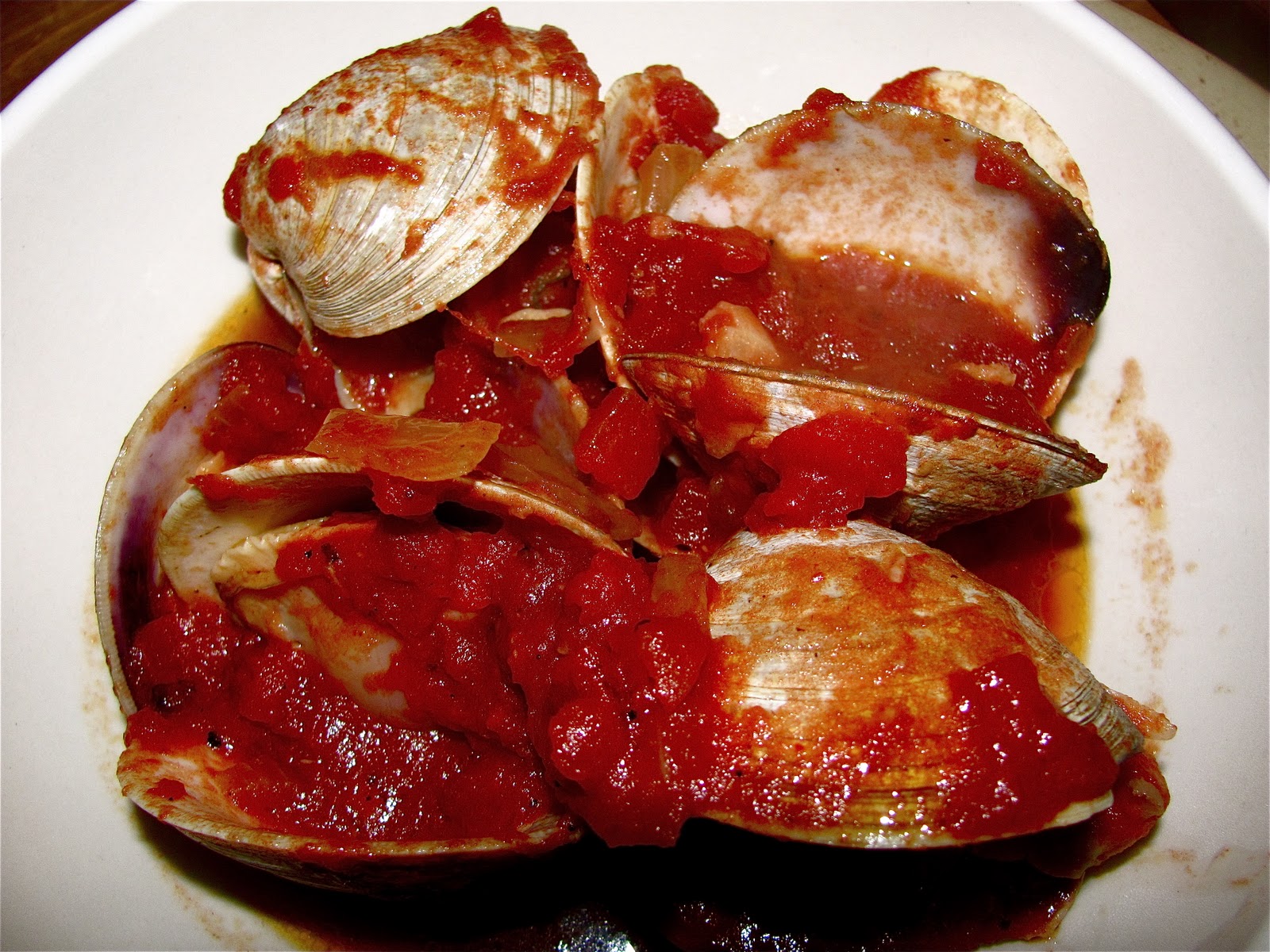

Clams Posillipo (basically steamed in a quick red sauce) is how our dinner began. It is said that Sinatra would often order two or even three plates of the clams at Patsy's.


I grew up on Stuffed Artichokes (though always at the end of the meal). Patsy's recipe includes chopped gaeta olives and capers, a nice addition to the usual breadcrumbs and cheese and herbs. I can see why Sinatra liked this so much.


Fusilli with Garlic and Anchovies. What is there to say? If a simpler vehicle for distributing such satisfying flavors exists I am not aware of it.
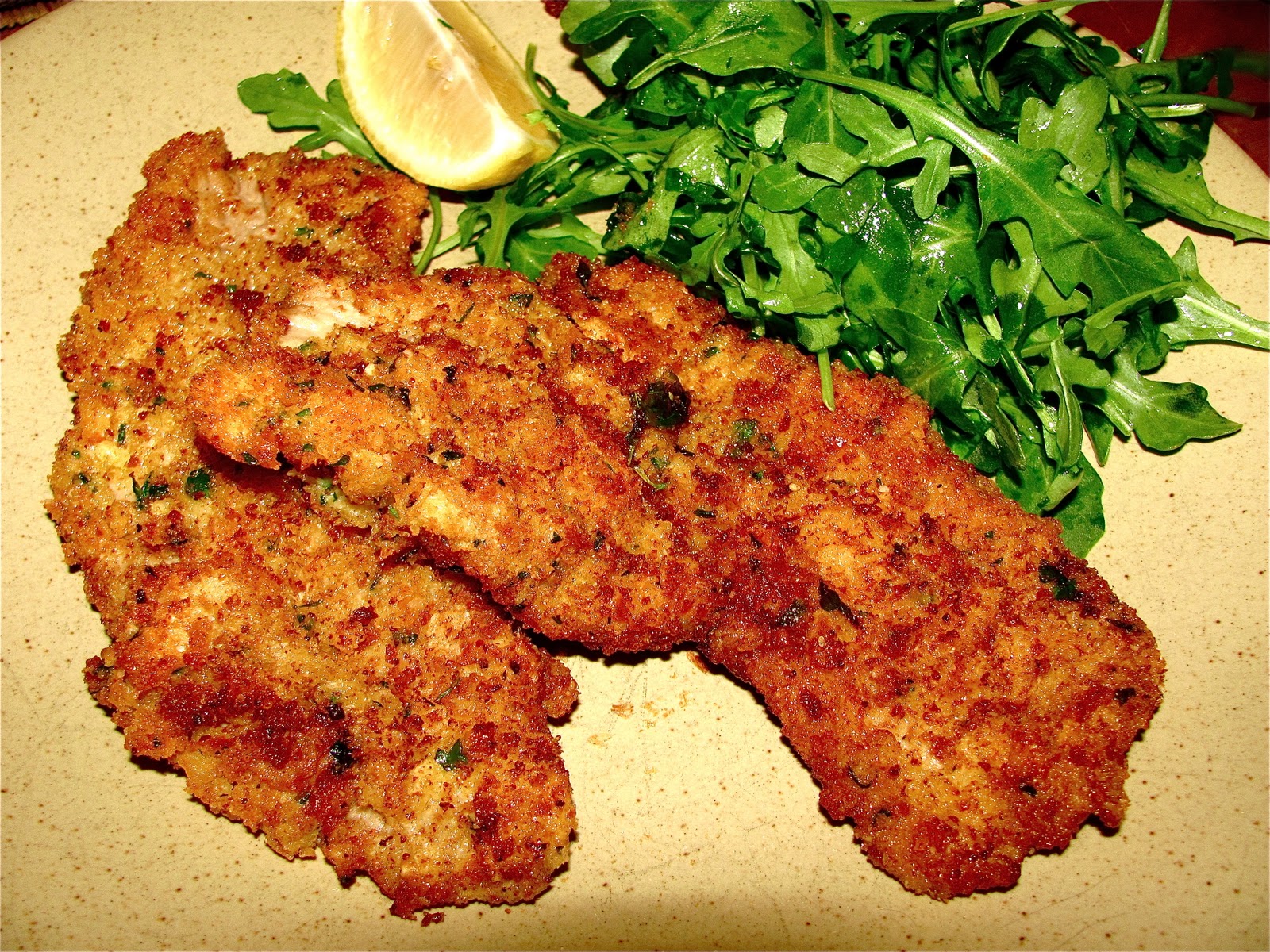

When I turned to the page in the Patsy's cookbook that marked Veal Cutlet Milanese as Sinatra's best-loved veal dish, I smiled for a very long time. Veal Milanese is a constant in my kitchen. If you have eaten at my home more than three or four times, the odds that I have not made a Milanese for you are approximately zero. You will notice that the Arugula Salad course is served alongside the veal. That's because, in my preparation, the arugula salad is normally served right on top of it.


Based on the rest of the meal its finishing touch, a Lemon Ricotta Torte, makes total sense to me. It is a classic, light, not terribly sweet ending to a pretty traditional and simple Italian-American dinner.

Sure, it would have been just swell to enjoy it sitting across the table from Frank. But a good time was had by all, I am pretty sure.


Oh, and the music playing away throughout the evening was not in any way dissatisfying either.

Monday, December 5, 2011

My best pignoli cookie


I am not going to bother being humble about this, okay. For some absurd reason I was gifted an ability to produce a fine pignoli cookie.

A very fine pignoli cookie.

As the holidays approach, I anticipate producing several batches of the chewy, almondy things. Just last week a delivery went out to Shyster Jersey Lawyer Friend. She had intervened on my behalf in a matter of (absolutely no conceivable) consequence. Still, my social etiquette-powered GPS pointed me in the direction of reciprocity. Shyster being rather sweet of tooth, cookies seemed the way to go.

A specialty of Southern Italy, pignoli cookies (so named for their outer layer of pine nuts) are a beloved dolce among Italian-Americans, especially around the holidays. It is not always easy to find a really good example of the cookie, as getting just the right texture and degree of sweetness can be tricky. Pignoli cookies must be chewy but not soft; sweet, but mildly so.

On the other hand, I can make a damned good cookie. So how hard can it be, right?


The full recipe for the dough is below, but there is not much to it at all; it is mainly almond paste and sugar, and takes only a few minutes to prepare. Once it's made just put the dough in a bowl so you can start forming the cookies. In a separate bowl you've got your raw pine nuts.


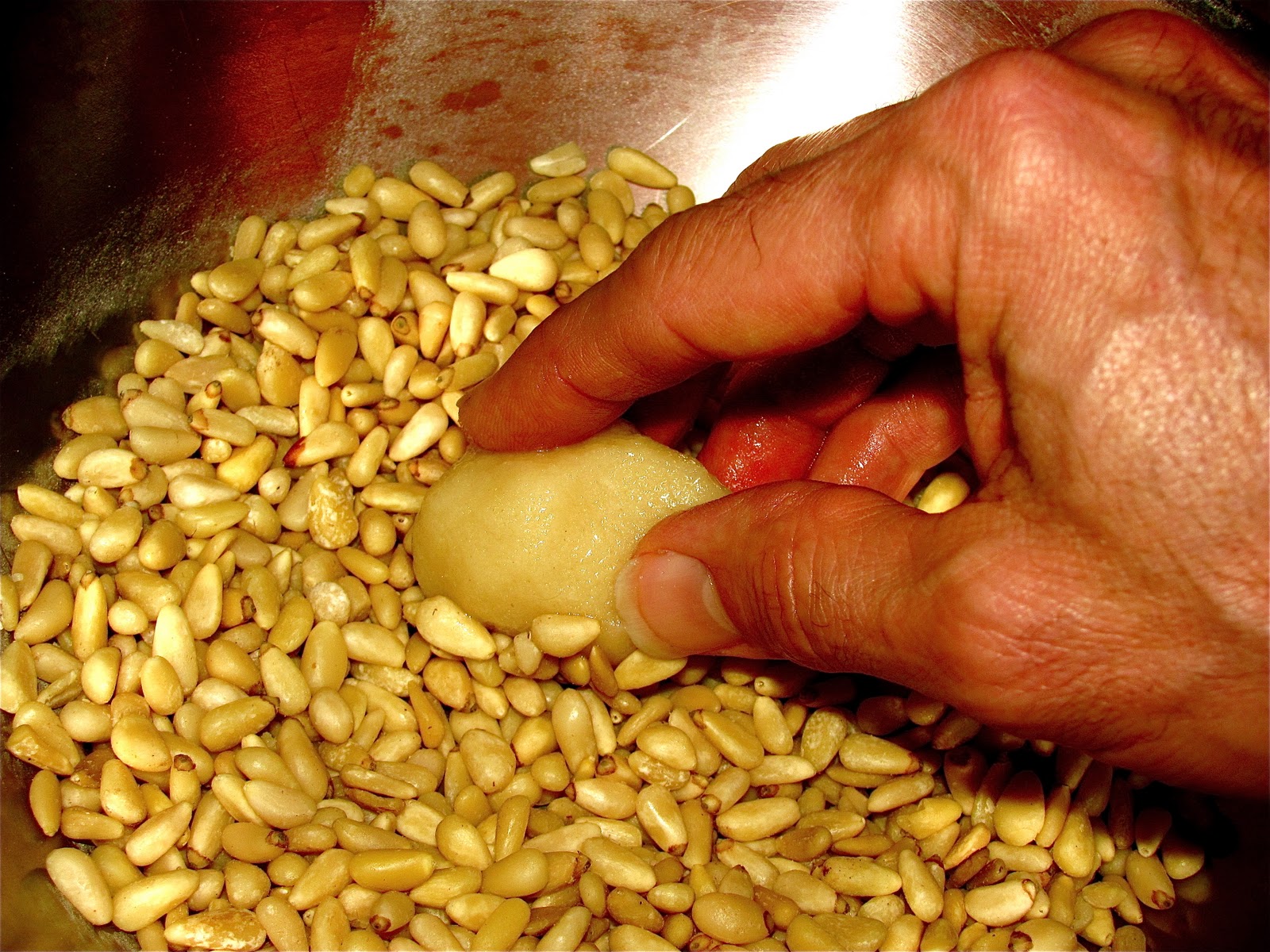
The size of the cookie is up to you, but I make them about two inches around. All you do is pinch a bit of dough with your fingers and begin to form what approximates a cookie shape. You'll see a separate bowl filled with water at the top. It's best to wet your fingers before pinching a piece of dough; things go a lot more smoothly that way, believe me.


The only thing left to do now is roll the dough around in the pine nuts.


Then arrange the cookies on a baking sheet lined with parchment paper and toss it in the oven.


About half an hour later you've got these pretty swell cookies to enjoy.

In this particular case it was a shyster lawyer from New Jersey who actually got to enjoy them, but you get the idea.

Pignoli Cookies
Recipe
Makes about a dozen cookies

1 8-oz can almond paste (do NOT use the tubes; the texture is different)
1/4 cup sugar
1/2 cup confectioners sugar
3 tbsp flour
1 extra large egg white
8 oz raw pignoli (pine nuts)

Preheat oven to 300 degrees F
In a food processor, crumble the almond paste, then add the sugars and flour and mix until fine
Add the egg white and mix until dough forms
Empty the pignoli into a bowl
Scoop out small amounts of the dough (wet hands help and so I keep a bowl filled with water on hand), then roll in pignoli until coated
Place on a baking sheet lined with parchment paper and bake for 15 minutes
Rotate the sheet and bake another 10 minutes, or until cookies are golden
Allow to cool, give a light dusting of confectioners sugar and serve

Wednesday, November 30, 2011

Homemade muffuletta


If you are about to get on a plane to New Orleans then I suggest you just move along. An authentic muffuletta sandwich awaits you, at Central Grocery in the French Quarter, and in no way could I compete with such perfection.

But I ain't headed down there, see. And neither are a lot of my peeps. For this reason, along with the fact that none of the foodservice establishments in my vicinity knows how to make a respectable version of the sandwich, I am forced go it alone when the mood strikes.

And it strikes often.

Often enough that I have taken to preparing the most important ingredient of the muffuletta, the olive salad.


These are the makings of a small batch of the olive salad. 


And here is the finished product. (See the recipe below.)

As for the sandwich's other ingredients, Central Grocery goes with a combination of salami, capicola, pepperoni, ham, provolone and emmentaler cheese. I am not strict on this point, and you shouldn't be either. My muffuletta rarely is missing a little mortadella, for instance. I find salami to be a critical ingredient as well, along with provolone. Beyond those three things I am pretty flexible.

The bread can be a touchy subject. Tradition calls for a soft, round, seeded Sicilian-type roll, and purists will accept no other. I just go with the best bread that's available at the time. 

On the other hand, if you happen to be in the Quarter and want to pick me up some authentic muffuletta bread, I would not be averse to accepting such a kindness.

Olive Salad Recipe
Makes 1 quart

1 1/2 cups green olives, pitted
1/2 cup Kalamata olives, pitted
1 cup Gardiniera
1/4 cup roasted red peppers
1 tbsp. capers
2 garlic cloves, chopped
1 tbsp. scallion, chopped
1/8 cup celery, chopped
1 tbsp. parsley, chopped
1 tbsp. oregano
Red pepper flakes to taste
3 tbsp. red wine vinegar
Salt and pepper to taste
Extra virgin olive oil

On a flat work surface crush all the olives, either by hand or with the flat surface of a large knife.
In a large bowl combine the olives with all the other ingredients except the olive oil.
After all the ingredients have been fully combined, pour an ample amount of olive oil over them and mix.
Empty into a 1 quart jar, close and refrigerate for about a week before using. This will allow the flavors to properly meld.

Sunday, November 27, 2011

How to make tortellini


Standing in my kitchen making fresh pasta is to me what curling up near a fireplace with a good book is to a lot of other people.

Nothing is quite so satisfying.

And so when a cold rain settled in for the weekend recently it didn't take long for me to decide what to do with myself. On Saturday morning I went and got fresh eggs from a nearby farm, because fresh eggs make better pasta than store bought. After lunch I prepared the pasta dough, wrapped it in plastic and set it in the fridge overnight to rest. By Sunday afternoon,when an even heavier storm was moving through, I was ready to get to work.


For the filling I decided to go traditional. Right here we have a raw chicken breast, an egg, a hunk of Parmigiano-Reggiano, breadcrumbs, fresh nutmeg, and a piece of mortadella.


The first thing to do is cut up the chicken and the mortadella (I had that hunk on hand but four slices from the deli counter should do), then run them through a food processor by themselves.


Then add about 3/4 cup of the grated cheese, maybe 1/3 cup breadcrumbs, the egg and a little ground nutmeg, plus salt and pepper.


After running all the ingredients through the food processor pinch the mixture with your fingers. It should be firm but not stiff. If it's stiff add a little milk or cream and process until fully melded.


Since there's raw poultry in the mix it's not cool to taste it to check that it's properly seasoned. So scoop out a little with a spoon and boil it in water a couple minutes. Then adjust seasonings as you like and taste test until you're happy with it.


For tortellini I roll out the pasta sheets with a machine, not by hand; on my machine I find the No. 2 setting to be the right thickness. Here I stuffed the filling into a sturdy plastic bag, cut a small hole in one corner, and am squeezing the filling onto the pasta sheets.


After doling out the filling you need to make the cuts in the pasta sheets; the individual pieces should be pretty much square.


Shaping the tortellini is basically a two-step deal. Here's the square that you start with.


All you do is fold one corner onto another. (If the dough is moist enough then the pasta ends should close up just by lightly pressing down along the edges. Otherwise use an egg wash along the edges before making the fold.)


Hold the filled pasta shell with both hands and then simply bring the two top corners together and pinch them closed.


And that is pretty much all there is to it.


Nine times out of ten I serve these the traditional way, en brodo, meaning simply in broth. Usually that means a chicken broth, and you can boil the pasta right in it rather than first boiling it in salted water.

This particular time a rather forceful companion expressed a clear desire for something a bit more colorful, and so I went with a simple fresh tomato sauce.

At times it is in one's best interest to be accommodating.

Monday, November 21, 2011

How to roast a chestnut


Saturday food shopping took a decidedly holiday-like turn when I noticed that two of the local food stores that I frequent (Rosemont Market and Micucci Grocery) had gotten in fresh Italian chestnuts.

I was in the middle of making a soup with these chestnuts (note to locals: Micucci's are a lot cheaper) when my friend Joe called. He had wanted to discuss matters relating to his business, except that as soon as he discovered what I was doing, all he wanted to talk about were chestnuts.

"I can't get a good chestnut panettone anymore," my friend moaned in a truly sorrowful way. "For awhile I had an outfit in Italy ship them to me, but I can't get them to do it anymore. I just gotta find another source."

As I know how much my friend loves his chestnuts, both in a panettone and warm out of the shell, this hurt my heart deeply. I do not like to see my friends suffering.

After several more minutes of chestnut talk he asked whether I would be blogging about the soup that I was preparing, but sounded less than enthusiastic when I said that I would.

"Nobody knows how to roast a chestnut anymore," Joe groaned. "All they know is opening a jar or a vacuum pack.

"If it were my blog," he went on, "I would just do that: How to roast a chestnut."

It is helpful to have friends who are smarter than yourself, don't you think?


The first step in roasting chestnuts is a little dangerous, so be careful and work slowly. Using a sharp knife, cut an "X" into one side of the nut.


After all the chestnuts have been scored soak them in water for about an hour. If you're in a hurry, 30 minutes will do, but they should be soaked at least that long. At an appropriate time in the process you'll need to preheat your oven to 400 degrees F and have a roasting pan on hand to accommodate both the chestnuts and some water.


These chestnuts roasted for 20 minutes. There are two things I'd like to bring to your attention. First, you can tell that the chestnuts are done because of the way the skin has curled up where the "X" was cut. If that doesn't happen then they need to cook longer. Second, there is still ample water in the pan. Some people use no water, others use so little that it evaporates entirely. I find using a good quarter inch of water works well.


Here's the soup that I wound up making, by the way. And a recipe from La Cucina Italiana should you be inspired to do so yourself.

I don't expect Joe to make it. He's too busy trying to track down his panettone. Poor guy.

Enjoy the Holidays.

Tuesday, November 15, 2011

What to drink with the bird


Once, during Prohibition, I was forced to live for days on nothing but food and water. —W.C. Fields

I know a couple of other wiseguys who like a good drink.

What's more, if provided just the right amount of inebriant, these friends of mine can be talked into anything. It was only three days ago when I floated the idea that they drop everything and compile a list of Thanksgiving wines and beers we can all enjoy on our holiday. And here we are.

Handling the wine picks is Scott Tyree. A wine professional of some standing, you may recall Scott from the time he expertly paired a bunch of wines with my meatballs. TH Strenk, a very fine home brewer, understands more about beer than anybody I know; he will do the holiday beer pairings.

Me, I'll shut up now. Have a wonderful holiday, everybody.

Cent'anni!


7 Great Thanksgiving Wines
by Scott Tyree

Lini 910 Lambrusco Rosé In Correggio 2010, Emilia-Romagna ($18) I know what you're thinking: Riunite on ice — niiiiiiiice. But one taste of this high-quality dry Lambrusco happily obliterates any memories of the cloyingly sweet, soda pop-like fizzy wine your auntie enjoyed sipping during the holidays. This wine is lush and creamy with rich red fruit flavors, a mineral tang and razor-sharp acidity. Best of all, it's blessedly bone dry. I wouldn't hesitate to drink the Rosé In Correggio throughout the entire Thanksgiving dinner.
Rolly-Gassman Gewurztraminer, Alsace 2009 ($28) Dry Alsatian Gewurztraminer is the go-to white wine that successfully navigates all the big bold flavors of Thanksgiving dinner. Think about it. All those warm spices used in the stuffing, sweet potatoes and sides pretty much reflect the exotic spicy nature of the gewurz grape.
Tenuta delle Terre Nere, Etna Rosato 2010 ($18) It seems most rosé wines are often unfairly marginalized and described as being "rustic" or "simple." The Terre Nere Rosato is neither. In fact, I'd say it's downright elegant. The grape is nerello mascalese, grown in the high elevations of Sicily's Mt. Etna. It's citrusy, delicately spiced and wild berry inflected. A perfect foil for the cranberry sauce.
Moulin-à-Vent Clos du Tremblay, Paul Janin 2009 ($15) All Beaujolais is not of the grapey, purple-hued, tongue-staining variety known as Beaujolais Nouveau. In fact, much of the region produces elegant wines that are soft, supple and excellent with food. Gamay is the perfect grape variety to pair with both dark and white turkey meat, and it will cut through rich sauces and gravy. Janin is a great producer.
Evening Land Gamay Noir Celebration, Eola-Amity Hills, Oregon 2009 ($20) An American Gamay that is juicier, rounder and more fruit driven than its French counterpart from Moulin-à-Vent. Undeniably pleasurable to drink.  
Umathum Zweigelt, Burgenland, Austria 2009 ($25) In keeping with the medium-bodied red wine theme. In contrast to the Gamay-based wines, Zweigelt grapes produce wines with an overtly savory character — lots of dark fruit, black pepper and herbal notes. Think a toned down, lean, less alcoholic zinfandel. Both styles work with T-day dishes.
Madeira, New York Malmsey Special Reserve, The Rare Wine Co. ($48) The versatility of Malmsey Madeira (also known as Malvasia Madeira) is impressive. I can't think of a wine that pairs so easily with pumpkin pie, pecan tarts, custard and chocolate. Tailor-made for Thanksgiving drinking.


How to Choose a Holiday Brew 
by TH Strenk

Matching beer to turkey is pretty straightforward. The trouble starts at the potatoes and pan gravy, chestnut stuffing, cranberry sauce, buttered parsnips, green bean casserole and grandma's pineapple gelatin mold with cherries on top. No one beer could cover all those bases. This style-by-style guide should help you to keep things balanced.

AMERICAN IPA IPAs are floral and citrusy on the nose, and bitingly bitter in the mouth. The theory here is that bitterness will cut through the heaviness of the unctuous gravy, a refreshing contrast to the big meal. Be careful not to choose a tongue-numbing "extreme" IPA, but one that balances the bitter with some malt. My choice is Southern Tier IPA.
DOPPELBOCK The dark German lager is fairly high in alcohol (6-8%), which will help you keep laughing at Uncle Teddy's bad jokes. It is less bitter than an IPA, but still refreshing. Doppelbocks will complement both the roast turkey and the marshmallow-topped sweet potatoes. There are plenty to choose from, including Ayinger Celebrator, Paulaner's Salvator and the American Troegenator. I'll go with Spaten Optimator.
PUMPKIN BEER This spicy amber ale isn't apt to work with anything on the table, but some people have come to expect it. (Not Meatball; he hates the stuff.) My pick here is Southhampton Pumpkin Ale, which offers good gourd flavor, with balanced spices and a little vanilla.
HARVEST SEASONAL These malty brews tend to work well with dishes that traditionally show up on the Thanksgiving table. Medium-bodied, Marzen and Oktoberfest beers are great with roast turkey and can handle most accompaniments. Top German producers Paulaner and Spaten brew good Marzens. However, my pick is Sierra Nevada Octoberfest.
SAISON This Belgian's dryness and acidity would be good foils for the fatty gravy, drumsticks and creamed onions. Its spice, usually coriander, complements the warm fall spices found in many harvest dishes, not to mention dessert. Saison Dupont is a solid choice, but I would pop for Brooklyn Brewery's Sorachi Ace.
IRISH STOUT Most American stouts are so full of coffee and chocolate they don't pair well with food. But the dry style of Irish stout is more delicate. It's also generally low in alcohol, which means you can quaff it all night. I'd go with the old reliable: Guinness.
SOUR STYLES These ales, fermented with wild yeast and bacteria, have bright acidity that perk up flavors and cut through fat. Traditional sour styles include lambic, gueuze, Flemish red and brown ales and Berliner weisse. Of these, Rodenbach Grand Cru is the easiest to find.
PILSNERS Sure, there's a craft beer revolution going on, but domestic and imported macrobrews still dominate. Not all Pilsners are pallid. The best are bitter, floral and dry with yeasty notes. My choice would be for the original, Pilsner Urquell, from the town of Pilsen in the Czech Republic.

Saturday, November 12, 2011

The book on the cook


I inherited precisely five things from my father after he died. Two of them, and for reasons that are inexplicable to me, are spoons. A big metal one I use for cooking vast quantities of sauces and such; a soup spoon with a black bakelite handle I reserve for comfort foods.

The brass knuckles that he kept in a metal locker in the cellar underneath the apartment building where we lived also came to be in my possession. In winter I used to wear them underneath a black leather glove when riding the A train through Brooklyn to get to high school. I only used the weapon a handful of times, always out of self-defense, though I may be undercounting here just a bit.

There was also a thousand-dollar check from a life insurance policy that was turned over to me when I became eighteen, five years, give or take, after dad died. I used the money, as best I can recall, to buy books and records and black-and-white film and drugs and Chinese food and gifts for a girlfriend or two. Unlike the spoons, which I still have, and the brass knuckles, which I don't, the money never meant much to me.

Then, of course, there is "the book." Like the spoons it has a distinct culinary bent. Also like the spoons, I will never part with it.

"Technical Manual 10-412" was released by the War Department of the United States in August 1944. A copy of TM 10-412, also entitled "Army Recipes," belonged to my father. He was a corporal in the Army, you see, and his station during his tour of duty was that of cook.

I would like nothing better than to tell you some of my father's mess hall stories; really, I can't think of many things that might make me happier. Except that I don't have any of my father's mess hall stories. Because the man never told me any of them. 

He was a quiet one, my father. I really cannot say what thoughts he may have had or positions he might have taken on the vast number of matters that make up a man's life.

Searching through his cookbook hasn't shed any further light, for here too he is silent. There isn't a handwritten scribble on any of the manual's two hundred and seventy pages. Not a single one.

I know this because I have gone through the pages hundreds of times through the years, each time searching for him and wishing that I'd missed something the time before.

I looked again just yesterday, in fact.

But he's just not in there.