Sunday, July 15, 2012

Not a Maine lobster roll


It only looks like something you'd find in Maine.


Here are the ingredients that I use to make a lobster roll. They are not at all traditional.

I served this to a person with deep New England roots the other day. She was polite, as proper New Englanders are taught to be, but that is all she was.

Want an authentic Maine lobster roll? You came to the wrong place.


Saute a garlic clove or two and some hot pepper in plenty of butter, but not for long, only enough to flavor the butter a bit.


Remove and discard the garlic and pepper.


There's a half pound of cooked lobster meat here, enough for two good sandwiches. Just add the meat to the flavored butter, salt to taste, saute for about a minute, and into the rolls it all goes.

Like I said, you won't find this in Maine. Unless you're headed to my place.

In which case bring along a couple bottles of white, would you.The lobsters I got.

Sunday, July 8, 2012

Spain wins!


Last Sunday, July 1, Spain beat the shorts off of Italy in the Euro 2012. We're talking four goals to none here, people. In soccer, that's a drudging.

Three days later, on the Fourth of July, I was made to eat not hamburgers or hot dogs or Italian sausage smothered in peppers and onions off the grill, but paella. It was a damn fine paella, one of the very best I have eaten, including those eaten in Spain.

But still, paella? On the 4th?

It did not occur to me that I was being made to answer for my team's humiliating defeat until later that evening, well after a splendid holiday meal with friends (none of them Spanish, by the way) had ended. A visitor to my Facebook page, viewing the picture you see above, asked (innocently, I think) whether I was celebrating Espana's decisive win over Italia.

"Ouch!" I typed sheepishly. "Hadn't thunk a that." (Proper English is not required in the world of social media, I find, don't you?)

Anyhow, I immediately confronted my associate, the one who had prepared the wonderful paella made of clams and calamari and chicken and sausage and shrimp, and demanded an explanation.

I didn't get one. In fact, I didn't get anything but a knowing smirk, clearly meant to be hurtful and unkind.

Like the team that could not once find the goal days earlier, I too was humiliated. At the hands of another who has not a drop of Italian blood running through their veins.

The recipe? That I got. It's a good one. Just don't gush over it too much, okay.

It's been a rough week. Unless you're Spanish.

My associate's excellent paella
Recipe

6 small sweet Italian sausages (about 1 lb.)
Salt and pepper to taste
4 bone-in, skin-on chicken thighs
1/4 cup olive oil
1 large onion, peeled and chopped
6 garlic cloves, peeled and chopped
2 large pinches saffron, divided
1/2 tsp. cumin, ground
2 cups short-grain rice, such as Bomba or Arborio
6-8 cups chicken stock, as needed
12 small hard-shell clams, scrubbed
3/4 lb. large shrimp, peeled and deveined
3/4 lb. cleaned squid, cut into bite-size pieces
1 cup frozen peas
1/2 cup roasted red peppers, sliced

1. Poach the sausages in water until just cooked through, about five minutes. Drain and cool, then slice.
2. Salt and pepper the chicken thighs generously. Heat the olive oil in a large paella pan or oven-proof saute pan over medium-high heat until the surface ripples. Add the chicken thighs and brown thoroughly, about 5 minutes per side. Remove the chicken to a plate with a slotted spoon or tongs, then add the sliced sausage and quickly brown, about 2-3 minutes. Spoon out the sausage into the same plate as the chicken.
3. With the pan still on medium-high heat, add the onion and cook until golden brown and softened, about 4-5 minutes. Add the garlic and cook until fragrant, about 1-2 minutes. Add 1 pinch saffron  and the cumin and stir.
4. Add the rice and cook, stirring, until it is completely coated with the olive oil and onions. At this point, the paella can be set aside until you are ready to finish cooking it.
5. Preheat the oven to about 425 F. Meanwhile, "bloom" the remaining saffron in the chicken stock by bringing it to a gentle boil and simmering for about 5 minutes.
6. Arrange the chicken and the sausage over the rice, and ladle on 6 cups of stock. Place in the oven and cook about 15 minutes, until most of the stock is absorbed. Arrange the shrimp, squid and clams, hinge side down, on top of the rice, nestling them in with a spoon. If the rice seems excessively dry, add stock as needed and return to the oven for 15 minutes (the rice should not be soup, but if it is starting to "crater" on top, you will need more liquid).
7. Remove the pan from the oven, scatter the peas and roasted pepper on top, add a little more stock if it seems dry and return to the oven for 5 more minutes.
8. Remove the finished paella from the oven and let it settle 10-15 minutes, loosely covered with a clean dish towel, and then serve.

Sunday, July 1, 2012

How to roast peppers


I go through a lot of these things, especially in the summer. Far more sweet peppers get run through the outdoor gas grill than anything else I can think of.  And practically every one of them is whole roasted.

This won't take but a minute, I promise.


All you do is fire up the grill and bring the temperature to around 400 degrees F or so. Then lay the peppers down and close the cover; flip them a couple times so that they cook evenly. (This works just as well in an indoor oven, but use a pan for the peppers to catch any moisture that leaks out.)


Once they're cooked toss the peppers into a brown paper bag and roll the top of the bag closed. This helps the skins to separate and peel off more easily.


Leave the peppers in the bag until they cool to room temperature, then peel them, remove the inner seeds and slice into whichever size pieces you prefer.


Toss the peppers with some garlic and extra virgin olive oil, then season with salt, pepper, and any herbs you might like. (Many people use vinegar as well, but I don't.)


And there you go. You can eat them right away or they'll keep for a while in the fridge.

Around here they don't last more than a day or two, and so pretty soon it's back to the grill for another round.

Monday, June 25, 2012

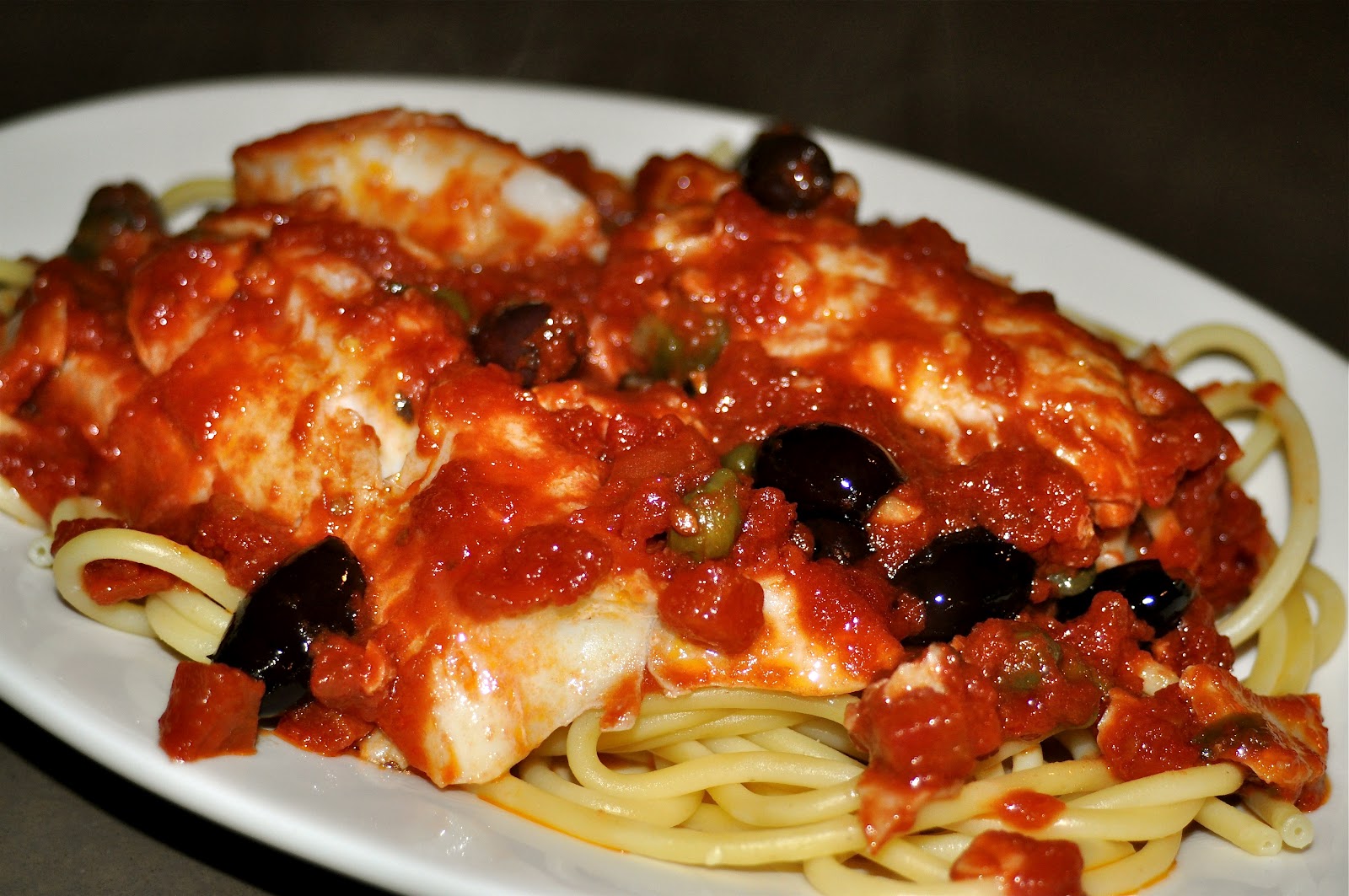
Haddock alla puttanesca


Whenever I need a good dose of old school Italian-style seafood I go to see John Conte. His restaurant, Conte's 1894, is a couple hours away from my home, true, but I make the trip gladly and as frequently as I am able. (Click this link and you'll see why I love his place so much.)

When I cannot make the trip but still have a craving I do what any self-respecting meatball would do: Imitate the master as best I can.

The haddock fillets that you see here were initially sentenced to a bleak end in a diet-friendly, excruciatingly boring oven broil. Then I stepped in and decreed (unilaterally and without debate) that we would offer the poor things the respect that they deserve and give them "The Full Conte." Which is to say pan cook them quickly in a nice red sauce and serve them over pasta. The way John would.

I decided on a puttanesca sauce for a couple of reasons. One, the flavor intensity is a nice contrast to the mild fish; and two, it's an easy sauce to make, half hour tops. (Hell, it took longer than that to wrest control of the evening's menu from the "responsible" adult in attendance.)


Saute some garlic, hot pepper and anchovy in extra virgin olive oil to get started.


Add in a can of crushed tomatoes, some Kalamata olives and capers.


Let it simmer, under medium heat, for maybe 15 minutes.


Lay the haddock fillets right on top of the sauce and turn up the heat.


Resist the urge to move around or turn over the fillets. Just allow the haddock to cook from the bottom up, while spooning some of the hot sauce on the topside.


Minutes later and you've got yourself a fine specimen of old school pan-cooked seafood.

It won't put Conte's out of business, but why in hell would I want to do that? Like I said, I don't mind the drive.

Haddock alla Puttanesca
Recipe

3 Tbsp extra virgin olive oil
2 garlic cloves, chopped
1 dried hot pepper, crushed
4 anchovy fillets
2 Tbsp capers, rinsed
3/4 cup pitted Kalamata olives
1 28-oz. can crushed tomatoes (preferably San Marzano)
1/2 tsp kosher salt
1 lb. haddock fillet
1/2 lb. cooked spaghetti

In a saucepan saute the olive oil, garlic and hot pepper for around two minutes, then add the anchovies and stir until the fillets are broken up.
Add the tomatoes, olives, capers and salt, stir and allow to simmer at medium heat for about 15 minutes.
Add the haddock fillet to the saucepan and turn the heat up to high. As the haddock is cooking spoon the hot sauce over the fillet so that it becomes covered in sauce. Cook for around 8 minutes or until the haddock is done.
Serve over the spaghetti, or another pasta of your choosing.

Monday, June 18, 2012

Pasta aglio olio e peperoncino


These are two of my favorite ingredients to cook with. And, as luck would have it, they add up to one excellent pasta recipe.

It does not get any simpler than this, folks. Except for olive oil and a little (optional) parsley, you are looking at the full ingredient list right here.


Aglio olio simply means garlic and oil. Alone they make for a very fine pasta sauce, but the addition of peperoncino (hot pepper) adds a nice kick.

Not that you need instruction, but here's how to make it.

Pasta aglio olio e peperonico
(Pasta with garlic, oil and hot pepper)
Recipe

2 garlic cloves, sliced
1 dried hot pepper, crushed
3 Tbsp. extra virgin olive oil
1 Tbsp. fresh parsley
1/2 lb. pasta (spaghetti works well)
Pasta water as needed

Begin cooking the pasta in a well-salted pot of water. (Reserve about a cup of the water after the pasta is cooked.)
In a saucepan saute the garlic and pepper in the olive oil at low to medium heat until golden but not hard.
Add the cooked pasta and half a cup of pasta water to the saucepan and mix thoroughly at high heat until melded. (Add more water if needed, but it should not be watery.) Toss in the parsley and mix some more.
Serve with or without grated cheese.

I said it was simple, didn't I?

Saturday, June 16, 2012

The dad days


This is my father. I don't know a lot about him, frankly. He was an orphan for a time, but the details on this are sparse and a bit murky. He was a cook in the army. I know this not because he told me exciting stories about his time in the war, but because his United States War Department cookbook is right here beside me.

My father has been gone since before I made it out of grade school. Between that and never becoming a dad myself (sorry, Otis, dogs don't actually count on these human holidays), Father's Day has been off of my radar for a very, very long time.

Then this old photograph turned up in the inbox the other day. It was sent to me by my brother Joe and it is the most perfect shot of our dad that I could imagine. He is standing behind the counter of our fountain service store in Brooklyn. It too shut down long ago, but the store is the archive of all the important memories of our father that we have. It is where he spent virtually every day after settling down to start a family. And so it is the one place where my brothers and I got to see him for extended periods. (The first exhilarating seconds that I pedaled a bicycle solo elapsed on the uneven sidewalk in front of the store, left to my own devices by dad's hand during a brief lull at the counter.)

By the look of things in this frame, it is summer. Dad is stationed at the Snow Cone machine, syrup bottles at the ready. To his left, the ice cream cone displays (two sizes of wafer, one sugar) are fully stocked for use. The sleeves of dad's always-white button-down shirt are elbow rolled for comfort.

Not visible in the picture, but surely present, are the wonderful people my mother relied upon to look after her husband should he falter. Somewhere in the store, I guarantee, is an aunt or an uncle, a niece or a nephew, a cousin perhaps, possibly a neighbor or a family friend who is prepared to step behind the counter and lend assistance if called upon.

These people may not be visible to you, I should say. Like dad, they are as clear as they can be to me, especially on a holiday such as this.

Happy Father's Day, everybody!

Sunday, June 10, 2012

Old school eggplant parm


This is the eggplant parmigiana that I was born to make. It is a proper, traditional, and very good eggplant parm.

It just isn't mine.

For reasons that I cannot quite explain, my method has long been to roast the eggplant, not to bread and fry it the way you are supposed to. (Here's my roasted recipe if, like me, you are moved to travel a different path).

I don't know what caused me to break from the elders in this matter. It's painful. We don't talk about. So please don't ask. Let's just get to the recipe, shall we.


To prepare an old school version of "the parm" you will of course need a large, firm eggplant. But having a close relation who has been around long enough to have attended the old school is even more useful. I've got Aunt Anna in my life, and she happens to enjoy cooking for me. Her simple eggplant parm is the best that I know, and so that is the recipe we will be going with here.


The eggplant is skinned and cut into quarter-inch-thick slices, which are dredged in plain breadcrumbs.


This is the (as yet unmixed) egg wash that follows the breading stage. (The cheese and lots of fresh parsley are key to this parm's perfection, I'm pretty sure.)


Dip the breaded slices in the mixed egg wash and into the hot olive oil they go.


Let the golden slices rest on paper towels to drain some of the oil.


Dip the slices in marinara sauce, line them in a baking dish, add a little mozzarella on top of each slice, then repeat the layers until you're out of eggplant.


Top the whole thing off with some more sauce and into the oven it goes.


I don't like my eggplant parm hot out of the oven. I like it at room temperature, and so that is how I enjoyed this one with my aunt.

It's better that way.

If you don't believe me, ask her.

Anna's Eggplant Parmigiana
Recipe

1 large eggplant, skinned and cut crosswise in 1/4-inch slices
Breadcrumbs for dredging
Olive oil for frying
1/2 lb. mozzarella, cut in thin slices
16 oz. marinara sauce of your choosing

For the egg wash
5 extra large eggs
2 Tbsp. fresh parsley, chopped
3 Tbsp. grated Romano cheese
Drop of water
Salt and pepper to taste

Preheat oven to 350 F.
In a bowl mix together the eggs, parsley, cheese, salt, pepper and water.
Dredge each eggplant slice in breadcrumbs, then in the egg wash.
Fry the eggplant in the olive oil until golden brown on both sides, then remove to paper towels.
Dip slices one at a time in marinara sauce and arrange in a baking dish until the bottom is covered.
Add a layer of cheese atop the slices, then repeat the layers until the eggplant and the cheese are used up.
Bake 30-45 minutes, allow to cool a bit, and serve.