Monday, May 16, 2011

Portland's Best Eats

The emails are just starting to come in. It happens around this time of year, as Maine's spring/summer visitors begin to make their plans. "Coming your way... where to eat?" is a common heading in the subject line. So is "Hungry, need advice," and the ever popular and always appreciated, "Help? Dinner's on us!" (Sometimes people actually make good on the claim.)

Normally I answer requests for dining ideas individually, but this year I've decided to be smart and put everything all in one place. A couple things to know up front, though: I've confined these suggestions almost exclusively to downtown Portland locations. This isn't a complete listing either. Some fine restaurants (Hugo'sBrescaBack Bay GrillEmilitsa) are absent, but only because I haven't been to them in awhile and prefer not to pretend that I have. By all means, look them up.

Bottom line? These are the places where I bring my own visitors when they come to Portland. No matter who's picking up the tab.

Best new restaurant
Petite Jacqueline is a French bistro that's owned by the people at the very popular Five Fifty-Five. I much prefer this new place, though I have to admit that I never understood the fuss over 555 in the first place. Jacqueline's food is a lot more honest. It's pretty traditional bistro fare set in equally traditional (casual) surroundings. And the prices ain't bad either. The very nice steak frites is $20, both at lunch and dinner. And the same twenty bucks will buy a full liter-sized carafe of perfectly serviceable house wine (if house wine's your thing, that is). The confit de langue d'agneau (lamb's tongue served over lentils) appetizer is fab, as is the housemade charcuterie (get the pig trotter terrine, it's terrific). The salade lyonnaise may be the best salad in town. And I'm told that the bistro burger ($9) at lunch is quite good.

Best high end meal on the cheap
If you appreciate the finer things but are on a budget, here's how to score a meal session at one of Portland's top two or three restaurants for not much more than going to Applebee's. You head on over to Fore Street and grab a seat at the bar. Then order yourself a platter of the wood oven-roasted mussels prepared with almonds and butter. They've been on the menu since Day One, cost $10, and are terrific. Plus, you'll get a basket of excellent crusty bread from Standard Baking Co. downstairs, which you'll need to sop up the sauce. With a glass of wine or a beer this can actually be a very nice light meal. I've made a night of it myself this way many times.

Best all-day dining spot
The Front Room, in the Munjoy Hill neighborhood, is very hard to beat here. Sure, it's one of only a few places in town that's even open for breakfast, brunch, lunch and dinner. But it's also got good food at very reasonable prices. Some of the things I like here: The potato gnocchi with bacon, spinach, two poached eggs and holandaise ($8) is very good. So are any of the $7 to $9 sandwiches (the BLT is a fave). At dinner, the spaghetti carbonara ($13) isn't always spot on but it can be very good. 

Best ethnic restaurant
Korea House is a family run place in the heart of the "arts district," such as it is, and is well worth a try if you like authentic Korean food. The dolsot bi bim bop ($15.95) is great, but so are most things on the menu. Try the seafood pancake ($15.95) as a shared appetizer, and I always get one of the simply grilled fish, like the mackerel ($13.95). The only downside is that the owners pay little attention to atmosphere, what people in the restaurant trade might refer to as "the concept's packaging." Korea House is strictly a space that has tables and chairs where people eat. If you're looking for high energy or a bar or a venue where things tend to happen, this isn't it. It's at 630 Congress St. (207-771-2000). Runner up: Tu Casa, Portland's only Salvadoran restaurant. I go for the menudo (tripe soup) on Sundays. I don't expect you will, but for good, honest ethnic food, Tu Casa is worth a visit.

Best places to get a banh mi
Whoever it is that runs the PR machine behind this Vietnamese sandwich needs to get a big fat raise. Seems the country is just lousy with banh mi. Portland now has its share of the sandwiches too. We locals rely mostly on two places: Kim's is a takeout joint at 261 Saint John St. (207-774-7165); get the barbecue beef. Saigon is a full-service restaurant, a good one, at 795 Forest Ave. (207-874-6666); I'm partial to their steamed meat banh mi, but the others are also good. Sandwiches at either place will only set you back around $3. Or, for an Americanized version, Nosh Kitchen Bar has a banh mi, with porchetta, for $9.

Best seafood restaurant
First-time visitors imagine Portland as a great seafood town, but the truth is that it isn't even close to being one. Street and Co. is the only seafood place I can even imagine suggesting here. It's been around forever, has gone through some ups and downs, but anybody who thinks there's better seafood in this town isn't paying attention. A sizzling pan of shrimp with butter and garlic over linguine ($21.95) is about as simple as it gets. Some would call that boring, but I call it one of the best dishes in town.


Best place for a brew
If you're an aficionado of fine beer, Novare Res is a must stop when in Portland. The 25 taps are rotating, which keeps the selection ever changing, and the bottle list is 300-plus labels long. The meat and cheese plates are good accompaniments to the brews, and an outdoor deck is secluded and great for hanging out in warm weather. Just one thing: Hours aren't nearly as accommodating as other places in town, usually beginning after the lunch hour or much later even. Check before planning your day around it.


Best burger
I'm gonna give it a tie for now. The bacon cheeseburger ($12) at District comes on a buttered bun, and both the bacon and the fries that come with it are top notch. Over at The Grill Room the burger ($13) is served on focaccia with tomato tapanade, roasted red onion and an absolute mountain of very good fries.

Best big city knockoff
Maine's attempt at mimicking David Chang's astonishingly successful Momofuku comes by way of one of Portland's most innovative chefs, Masa Miyake. Pai Men Miyake is the chef's second restaurant here, and though it's not nearly as interesting as Momofuku menu-wise, it's the closest you're gonna get to such things up this way. At the very least grab a beer at the bar and order the pork buns ($9) as a snack. Miyake's other restaurant, the very fine Miyake Food Factory, is moving to new digs this summer.


Best place to eat breakfast outside
While most other visitors stand in line for just-okay grub at Becky's Diner, you will discover far better food and atmosphere at Porthole. In good weather, the very large outdoor deck on the water makes for a swell morning hangout. And they have a bar.

Best pizza
When my cousins visit from New York they always want to make a stop at Micucci Grocery for a "Sicilian Slab" or two. The pizza oven is up a few steps from the wine department, way in the back of the store. It's mostly for takeout, though there are two tables where you can eat if you'd prefer. I've never had a single complaint on this suggestion. Never. And my people know their pizza.

Best $1.85 you'll spend in this town
Standard Baking Co.'s morning bun has been a staple around these parts for a long time. There's a reason things become staples, you know. It's at 75 Commercial St., 207-773-2112.


Best sweet indulgence
Gorgeous Gelato is a must stop if you enjoy the Italian frozen sweet. A Milanese couple opened the shop just last year, and I can't stay out of the place. It's the richest, creamiest gelato I've had stateside. It's even better than a lot of gelato I've had in Italy. No lie.

Best place to stop if you get lost
Should you stray outside of the center of town, the Great Lost Bear on Forest Ave. has been a local hangout for burgers and brews for more than 30 years. Like chicken wings? The buffalos ($12.99 for two pounds) are a meal unto themselves. They're good, too. Of course, the big draw at the Bear is the nearly 70 beers on tap, 50 of them from Northeast breweries and plenty from Maine. My favorite local brewer, Allagash, is well represented at the Bear. Give one of their brews a try; you won't be sorry.

Best place to just drop by and see
You may have heard about the restaurant carved out of a defunct (though rather grand) old church? Well, this is it. Grace isn't the best restaurant in town, but it's certainly the most unusual you'll ever see. I'd suggest having a drink at the very impressive-looking bar, then moving along. 

One other thing: If you do happen to be interested in surrounding areas, here's a coastal dining guide I put together last fall. Enjoy your trip.

Tuesday, May 10, 2011

Laura, Queen of Doughnuts


How far would you travel for a doughnut?

For instance, have you any interest in riding your motorcycle 150 miles roundtrip to Randy's in LA — in the rain? What about hopping in a friend's VW van for an overnight run to Saint Louis, so as to hit The Donut Shop just as its doors open at 4:30 a.m.? Road trip not your style? Fine, there's always the option of cashing in some frequent flyer miles and hopping an Alaska Airlines flight to Portland and to Voodoo Doughnut for a Bacon Maple Bar — then catching the next available flight back home.

I will admit to being acquainted with the (let's face it, guys) lunatics who chose to do such things, but do not count myself among their ilk. For one thing, I don't like doughnuts enough to go so far out of my way to eat them. And about the only doughnut I have any interest in is a plain one — but only if a plain cruller isn't available instead.

There is one exception to my no-drive, no-fly policy. And, yes, it involves another of my dearest family members. You got a problem with that?

I recently was summoned to the Doughnut Queen's home (in Queens, no less; ten minutes from JFK if you're thinking of cashing in miles). She and her trusted assistant Dominic were about to conjure a batch of, well, do I really need to say? And I was offered an opportunity to observe.

This cannot possibly sound like a big deal to any of you. How could it? But were you a member of my family, you would have an altogether different view. You see, of all the clan members (present and past) who have attempted to mimic "Aunt Laura's Doughnuts," not one has reported a satisfactory result. I mean it, not a single one. And I do not hail from a family of hapless kitchen dwellers.

None of us can understand this, least of all the queen herself. "It's flour, it's sugar, it's eggs and it's milk," she has told us all a thousand times. "I don't know what else to tell you." (The royals in my family are prone to using more colorful language than this, Laura especially. I have decided, in this instance, to edit my dear auntie's flowery, albeit immensely descriptive speech. You understand. I only hope she does.)

Anyhow, if my aunt doesn't know what the big mystery is all about with these doughnuts, then what makes you think that I would? I have never made a doughnut in my entire life. And do not plan on ever making one, what with the carnage I have witnessed involving loved ones who have crumbled to tears by their failure to produce a proper bit of, geez, fried dough?

Besides, I don't need to know how to make the damned things. If I want a batch of perfect plain doughnuts I know just where to find them. And so that's what I did.


This is a big old mess of Crisco, scooped from a brand new can of the stuff that was about the size of my head. I asked Laura what she was planning to do with so much shortening, but can't possibly repeat what she told me. Anyway, the shortening is in a frying pan. The heat is on low so that the Crisco can melt while my aunt prepares the dough.


The recipe's below, but it all starts with mixing eggs and sugar together.


Then adding milk and some of the melted Crisco.


Next you mix in some flour and baking powder so that a moist dough forms.


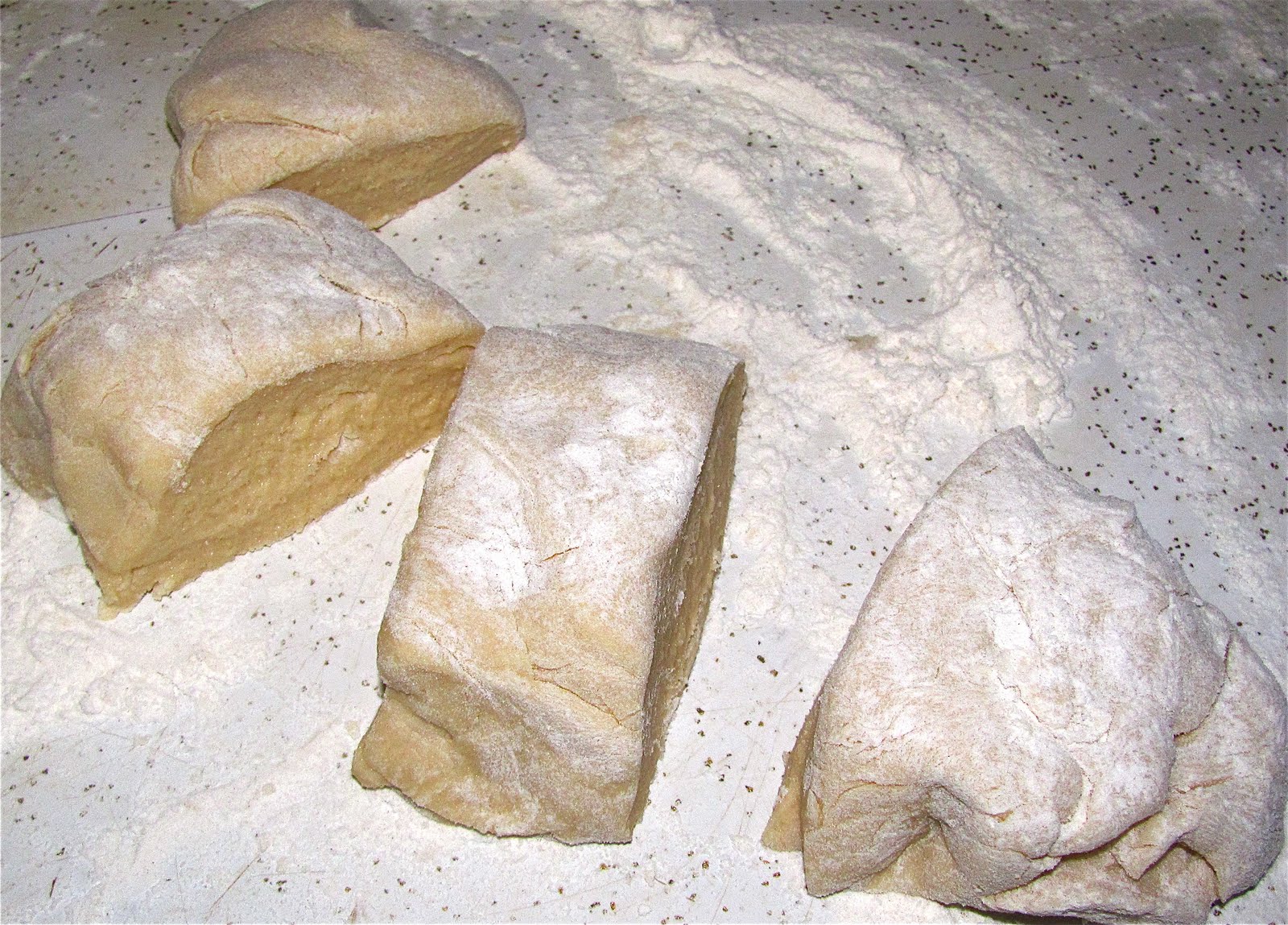
The dough gets turned out onto a floured work surface, kneaded a little, then is cut into four pieces.


You roll out each piece of dough, so that it's about an inch thick, then start cutting the doughnuts.


Like so.


Fry them up until nicely browned on both sides. (The cruller Laura made for me, by mixing together some of the doughnut holes. Thanks, aunt.)


Remove to a colander and allow to cool a little.


Top with confectioners sugar and there you go.


After the demo was completed we sat around the dining room table and visited over a fresh pot of coffee and the newly minted doughnuts. I asked Laura if she had an actual recipe and was quickly provided these index cards. Then, when I asked how long she had been making her doughnuts, Laura looked at Dominic, her devoted husband of sixty-six years, and said, without hesitation, what to members of my family will always be magic words: "Since 753."

That would be 753 Liberty Avenue, in the East New York section of Brooklyn, the place, along with the adjoining 751, where we all grew up. Together. (We're talking Old World here, people. Two buildings, six apartments, each headed by a child of my maternal grandparents.)
I pressed further still and asked where my aunt had gotten her doughnut recipe, only to hear the dreaded words, "I have no idea."

Then Dominic wondered aloud whether it might have come from "those A&P books," and to test his theory disappeared to another room for around 30 seconds.


When he returned the mystery had been solved. For around 45 years Laura has been making doughnuts from a recipe that appeared in Volume 4 of the "Woman's Day Encyclopedia of Cookery." The 12-volume set was published in 1966, and my aunt, like a lot of women of her day, bought the books, one by one, at the A&P supermarket (on Fulton Street, in this case) for about $2 apiece.

I cannot tell you how amused my aunt was to learn the origin of her doughnuts.

But I'm not gonna repeat the word she used.

Doughnuts
Recipe

2 large eggs
1 cup sugar
1 cup whole milk
5 Tbsp melted shortening
4 cups all-purpose flour
4 tsp baking powder
1/4 tsp nutmeg, lemon rind or cinnamon (optional; my aunt doesn't use any of these)
Shortening for frying

In a bowl, beat the eggs, then mix in the sugar.
Stir in the milk and melted shortening, then mix in the flour and baking powder until a moist dough forms.
Empty out onto a floured work surface and knead the dough a minute or two.
Cut the dough into four separate pieces, then roll each to 1/4-inch thickness, then cut the donut shapes.

Heat shortening in a frying pan. There should be enough so that the doughnuts can float.
Test by frying one of the "doughnut holes" before frying the doughnuts.
Fry doughnuts until golden on side in shortening, then flip and fry other side.
Remove to colander or surface lined with paper towels, allow to cool, then sprinkle with powdered sugar and serve.

Tuesday, May 3, 2011

Mr. Braciole's spaghetti pie


I know a guy lives in... Wait, I ain't supposed to say. So this guy is a... Know what, skip that one too.

Maybe we should just stick with what this person cooked for me the last time I swung by his... What I meant to say was, the last time we saw each other — at a location I am not able to recollect right at the moment or, likely, ever. I remember that the place had a kitchen, but that's it. Could've been anyplace. Anyplace at all.

I know this guy as "Johnny Braciole," but you would not be wrong to question whether this is his given name. I mean, what kind of a person would name their own child after a rolled up piece of beef, am I right?

He's a good cook, this Braciole. Nice enough fella too. I think he has a family, maybe a wife (let's call her Susie, for the sake of argument) and a daughter (oh, I dunno, how about Jennifer, let's say). But, again, I am not at all certain on either of these points, so stop with all the questions already!

The only thing I am sure about is that the spaghetti pie Mr. Johnny Braciole threw together when last we met was one very fine example of the item.

For reasons that I am not at liberty to convey, the man has an aversion to recording devices being used in his presence (he's shy, okay). However, as we have been close for so many years, I did manage to shoot a few frames of the pie-making proceedings.

Wait a minute, did I say we were close? I swear my mind is starting to go. He's an acquaintance, this Braciole. Got that? I would not know how to get in touch with him, for example, should anybody be of a mind to come into contact with the man. For whatever reason.


So you got your eggs and your grated cheese. (You don't see nobody in the reflection there, do you? Me neither. Phew!)


Which gets mixed together with the spaghetti, of course. (What, you were expecting ziti?)


Throw it in a baking dish and top with some more what? Right, cheese. (You've been paying attention.)


And there you go. Johnny Braciole's famous (he calls it that, and I am not of a mind to argue with the man) spaghetti pie.


The Braciole does not look anything like this today (he has undergone some alterations, shall we say). This is an old pic that I do not think he would mind my showing you. Don't ask me what's going on in this frame, please, because I have no idea. Like I said, I'm not that close with the guy and am certainly not privvy to any strange "habits" he might enjoy.

I will say this, though: The lady he's with? Looks a lot like my cousin Vito.

Only my cousin's cuter.

Johnny Braciole's spaghetti pie
Recipe

1 lb cooked spaghetti (make sure it's al dente)
9 eggs
1 cup grated Italian cheese of your choice
Salt and freshly ground pepper to taste

Preheat oven to 350 F
While the pasta is boiling, beat the eggs in a large bowl, then add in 3/4 cup of the cheese, salt and pepper.
After the pasta is done cooking, let it cool a bit, then add it to the egg and cheese mixture.
Grease a 9- by 12-inch baking dish, add all the ingredients, then top with the remaining cheese
Bake covered in foil for about 20 minutes, then remove the foil and bake for another 10 minutes, or until the top is nicely browned

One more thing. You didn't get this recipe from me, okay. Understand what I'm saying?

Tuesday, April 26, 2011

How to make a meatball

Promises and pie crusts are made to be broken.
—Jonathan Swift

Not around here they ain't. I promised some people meatballs (you know who you are and why) and meatballs I am delivering.


To make a good meatball you must first prepare your sauce (aka gravy). Why? Because the sauce is what the meatballs are cooked in. At least mine are.

I never make a Red Sauce exactly the same way twice, but there are three ingredients that are always in there: plenty of extra virgin olive oil, garlic and pork. The pork (often a mixture of ribs and sausage, though here just the ribs) is browned so as to render some of its fat, then removed until the tomatoes go in. The dark spots you see here? Anchovies. I use them sometimes. Even if you wind up not tasting them, when they're in there I find I need to use less salt.


I won't go through the whole red sauce-making ritual, but just so's you know what else went into this particular one before the tomatoes, pork and meatballs did: You've got your onions, your celery, some diced prosciutto, salt and pepper, and carrots for a little sweetness (some people use sugar, but this has always seemed a better method to me).


I always make my meatballs the same way—and always make them while the sauce is cooking. (I am not unique in this way, as generations of my people walked this same path.) The ground meat you see here is two-thirds veal, one third beef. I know. Where's the pork? It's in the gravy, not the meatballs.


A loaf of bread, an open faucet. More crucial elements to a good meatball you will not find.

I do not use breadcrumbs. Never have. I soak a loaf of bread in water, then gently squeeze a lot of the water out and start tearing it apart. As for bread, I usually grab one of those soft loaves that a lot of supermarket bakeries make. The reason I like this bread is because even the crust breaks down when you wet it, and I use the crust. But most any bread will do.


If you click on this pic you will get a better idea what's going on. Look at the ring of meat and notice that the veal and beef has been mixed but only lightly. This is very important. A meatball mix must be handled gently (I only use my hands, by the way, never a utensil). Mix it only as much as it takes for the ingredients to come together, and that's it. Never overwork it. One of the reasons why meatballs can be tough, heavy and way too dense, rather than tender and light, is because they have been worked too hard.

As for the ingredients, this batch is a fairly big one. There are about two pounds of veal, a pound of beef, two eggs, about three-quarters of a loaf of wet bread and a good dose of milk, which I keep adding as needed to keep things moist. The only seasoning I use is Kosher salt and freshly ground black pepper.


Here's another pic worth enlarging. See how moist the mixture is? Just as important, notice that I do not try to get things completely smooth and uniform. If there are hunks of bread in the meatballs, fine, I like bread. It goes back to not overworking. Very important.


Next step is to fry up a small piece of meatball mix to make sure it's seasoned to your liking. With meatballs that are mostly veal you may find it necessary to use a little more salt than if pork was an ingredient.


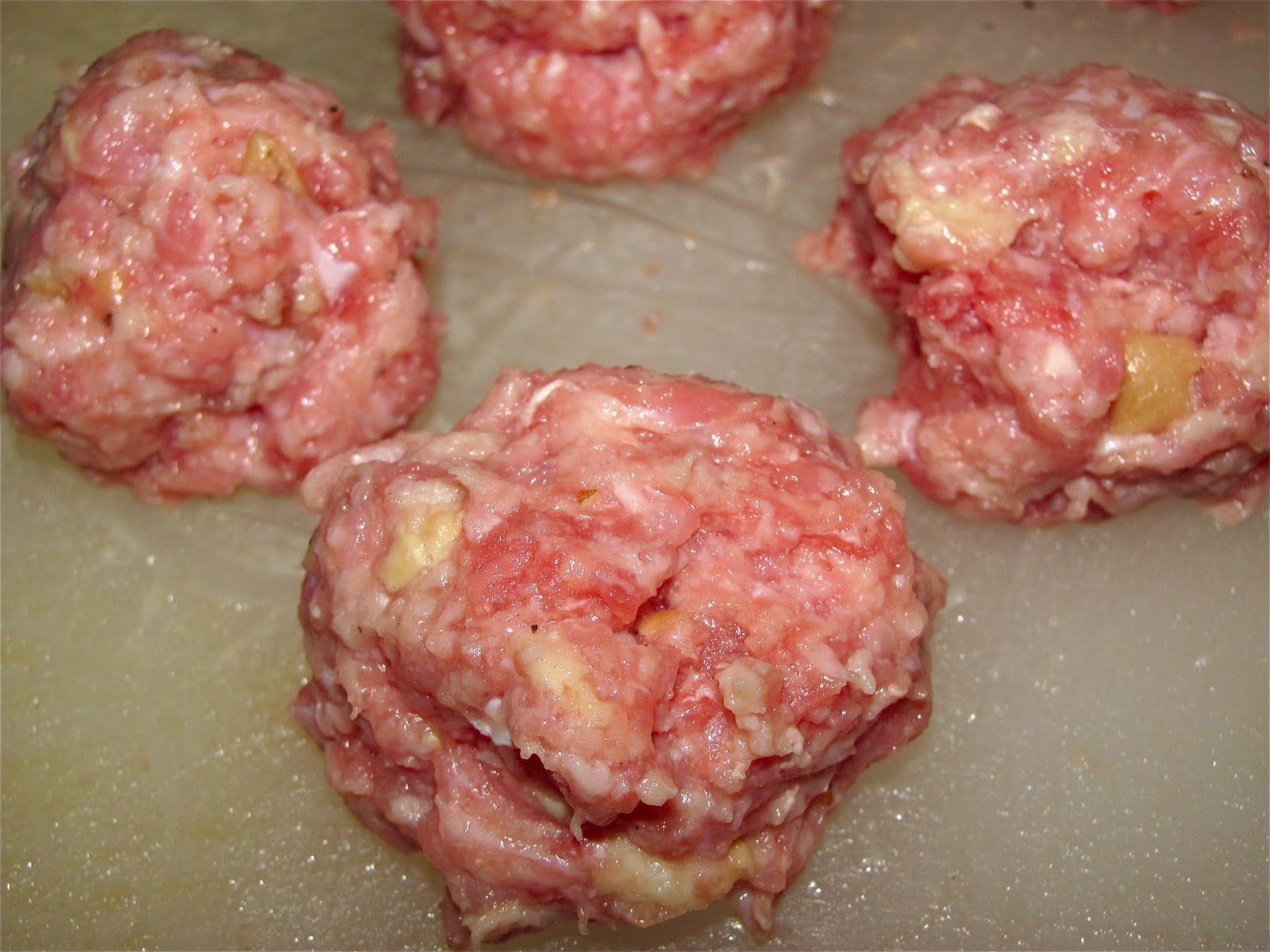
Time to make the balls. Again, don't overwork them here either. Using only one hand, just pinch some mixture from the pile, roll it ever so softly using your fingertips for a couple seconds and that's it; into the olive oil-soaked hot frying pan they go. Don't compress the meat or roll it in your palms or anything like that. Remember, the idea is to keep things nice and loose.


Some people bake their meatballs; I only fry them. But I don't cook them, I only brown them a little. These meatballs are coming out of the pan right now. I know. They're raw. They're supposed to be.


This is how my meatballs look just out of the frying pan.


Here is where they cook all the way through. This sauce is pretty much done already and so the idea now is to simply allow the meatballs to cook in it. But they should never cook at a hard boil. Just keep things at a very gentle simmer, for maybe half an hour. Cooking them this way, I find, keeps the meatballs moist and prevents them from getting stiff.


Moist and juicy. Like so.


Oh, and before I forget. Always make sure to fry at least a few meatballs until they are fully cooked, then set them aside for snacking. You will be happy that you did this, I assure you. Sunday mornings when I was growing up, I woke to the aroma of two things: my mother's gravy and her fried meatballs. To get to the bathroom you had to walk through the kitchen, and so before I'd get to do my business I'd get to taste my mother's meatballs. Two of them, actually. The first was always right out of the plate of cooked meatballs on the stovetop, the second I dipped in the gravy. By the time day was done I'd have put away at least a dozen more. 

Some years ago an associate attempted a numerical calculation of the meatballs I had consumed to that date. Unable to cope with the magnitude of digits in her charge, the project was abandoned, but not before the weight of it took its toll. I have a memory of the poor woman running down Tonnelle Avenue in Jersey City, half naked and screaming, incoherently as best I can determine, about how the giant meatballs and the flying monkeys were conspiring to take over New Jersey, or, at the least, Hudson County. It was a sorrowful ending to an otherwise promising endeavor.

As for my associate, she is still with us. Only, please, do your old pal Meatball a favor and do not under any circumstances show her this post.

There will be more meatballs in it for you. 

I promise.

**********************************
THANK YOU VERY MUCH!
MISTER MEATBALL has been voted Best Food Blog of 2011 by the readers of the Portland Phoenix. I'm really grateful to everybody who voted for the blog. It means a lot, and I thank you all very, very much. Grazie mille! —MM

Reprinted from the Phoenix
Best Food Blog: Mister Meatball
Warning: Do not read the Mister Meatball blog on an empty stomach. You will get more hungry and your stomach may start to growl. The recipes Mister Meatball writes about — many of them Italian or Italian-influenced — are drool-worthy: polenta lasagne with meat sauce, farinata (a breadish thing made with chickpea flour), sesame seed cookies, and octopus salad, just to name a few. Easy-to-use recipes are interspersed with memories of growing up in New York City (he's a Mainer now) and other anecdotes. This is a guy you'd want to invite over for dinner (as long as he cooks).

Wednesday, April 20, 2011

Aunt Anna's Easter grain pie


I know it's a little late in the game to be posting Easter recipes, but I just left Anna's place an hour ago. My aunt does not normally make her "grain pie" four whole days before the holiday, but she did so this time so that her "rotten nephew" could "take his pictures" for "that meatball thing he does."

Careful readers of this blog will know that I would like nothing more than to go on and on about my dear (and colorful) aunt. But time is getting short for those who are planning to bake during these next couple days, and so I will (sadly) get right to the recipe portion of our program.

Easter grain pie is one of only two dessert items on my Top 10 Foods of All Time list (sfogliatelle being the other). The pie's proper name is, well, that depends on whom you ask. The three most common are Pizza di Grano, Torta di Grano or Pastiera di Grano. It is, as best I can determine, a Neopolitan specialty, a notion that bears some weight, as Naples is where my family's roots run.

Like Pizza Rustica (aka "Easter meat pie"), Pizza di Grano is almost never made any time but around Easter. Only twice have I had it outside of this window, both times because I begged and pleaded to my dear friend Beth, Queen of the Bakers, to please, please, please devote a few hours of her busy life to making me one. (That is a troubling pattern I just now noticed, me cajoling women into baking fine pastries for me I mean. Hm.)

Perhaps we ought get to the demonstration. 


Anna's grain pie crust is among the thinnest I have witnessed. It is a fine crust, and here is its beginning. (The full recipe is below.) I asked her the reason behind her method of using room-temperature butter instead of ice cold butter and she smacked me across my head and told me to shut up. (Later she apologized and said that she just does, that's all. I made sure to be standing several feet away when broaching the subject this time.)


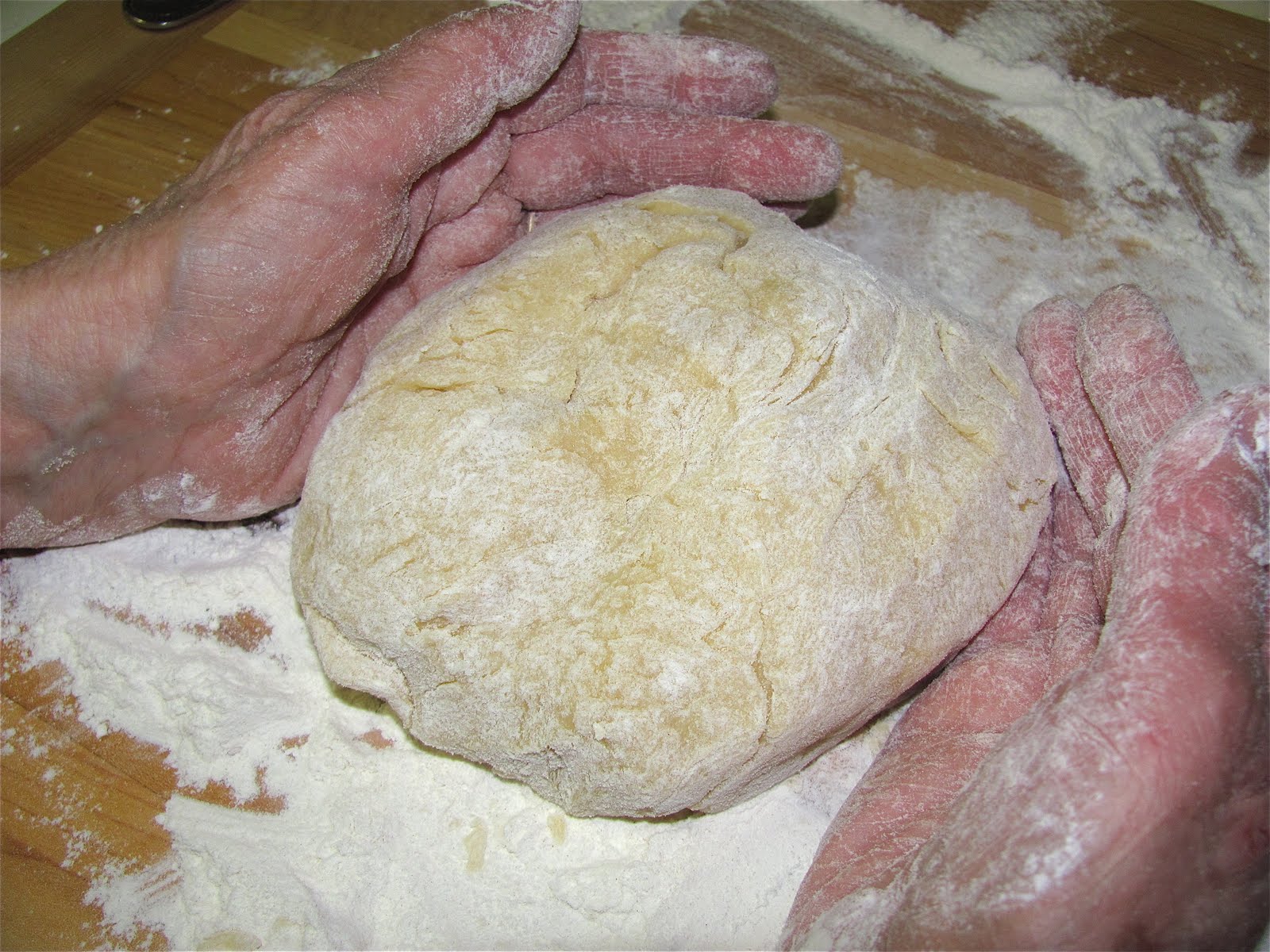
The only photograph of my aunt that she will allow me to use is this one. This is the finished dough she is caressing, in case you were wondering.


All rolled out and ready for the filling.


The filling, a mixture of cooked wheat berries, fresh ricotta cheese, eggs, sugar, pastry cream and orange zest.


That's the grain you see poking out of the filling. 


Before it goes into the oven the pie is topped with these cut strips of dough.


I've got prettier pictures of whole slices, but decided to go with this one instead.

A beautiful thing, no?


Easter Grain Pie (Pizza di Grano)
Recipe

For the crust
2 cups all-purpose flour
4 Tbsp sugar
1 stick sweet butter, softened
3 large eggs 
Pour flour out onto a work surface and create a circle in the center. Beat the eggs and sugar together in the circle, then add the butter and begin working into the flour until a ball forms. Allow to rest a few minutes, covered.
Divide into three equal parts, leaving enough dough to form cross strips on top of the pie. Roll the three pieces of dough so that each fits a 9-inch pie dish.

For the grain
1 1/4 cup wheat berries
Peel from one orange
1/4 cup sugar
Soak the grain in water overnight, then drain. In a fresh pot of water add the wheat berries and the orange peel and bring to a boil. Cook 20 to 30 minutes then drain and discard peel. While still warm mix in the sugar.

For the pastry cream
2 large eggs
2 large egg yolks
1/2 cup sugar
4 Tbsp flour
1 cup milk
Whisk the eggs and egg yolks in a bowl, then whisk in the flour and sugar. Add the milk and whisk together, then transfer to a saucepan. Cook at low heat, stirring frequently, until mixture comes to a boil and thickens. Allow to cool.


For the filling
1 dozen large eggs
1 cup sugar
3 lbs. fresh ricotta
Zest from 1 orange
Pastry cream
Cooked wheat berries
Beat the eggs and sugar together in a mixer, then add the ricotta, orange zest and pastry cream until well blended. Turn off the mixer and fold in the wheat berries.

Pour the mixture into three 9-inch baking dishes, top each pie with strips of pastry dough, then bake for about an hour at 375 F.
Allow to cool thoroughly before eating.

Sunday, April 17, 2011

Trippa e fagioli


Sounds better in Italian, don't it?

It's tripe and beans.

You may commence to getting the hell out of here while the getting is still good. Nice chattin' with you.

Okay, to the three of you who are still with me, here is what went down. It was a rainy day and I was about to cook up a nice pot of bean soup, with the cannellini beans from my garden last summer (I froze a bunch while they were fresh out of the pods). Then I found myself on the phone, talking about how you see more tripe on restaurant menus these days (it's true, don't you think?), and, well, you know.

If you are of a mind to try this recipe, let me say two things. First, there was no recipe, I just played around and this is how things turned out. Second, things turned out really, really well. 

I'm glad I wrote everything down. Even if only the four of us care.

Tripe and beans
Recipe

4 lbs. beef tripe
1/4 lb. bacon (or pancetta), diced
1 lb. sausage meat
2 large carrots, diced
2 large celery stalks, diced
1 large onion, chopped
4 clove garlic, crushed but left whole
1 hot pepper or pepper flakes (optional)
1/2 cup dry vermouth or white wine
4 cups cannellini beans
12 cups chicken stock
Rind from Parmigiano-Reggiano cheese
Salt and pepper to taste

Rinse the tripe well then cover in water in a large pot and bring to a boil. Cook for about an hour, then drain and allow the tripe to cool enough to handle. Once it's cooled, cut into 1-inch pieces.
In a pot large enough to accommodate all the ingredients, brown the bacon, then add the sausage meat and brown it too.
Add the carrots, celery, onion, garlic and pepper and saute for around 10 minutes, then add the vermouth and cook until the alcohol evaporates.
Add the tripe, beans, stock, cheese rind (I used two thick hunks), salt and pepper and cook for an hour or so.

Monday, April 11, 2011

Peppers and eggs


I grew up behind the counter of my family's fountain service store. We made sodas by mixing together flavored syrup and seltzer water, malteds with hard ice cream and real malt, sundaes, frappes and, of course, egg creams. (A separate item on the iconic Brooklyn beverage is in the planning stage. First, and in order to prepare a proper egg cream, I must get to my friend Joe's house in the Hudson Valley, he being the keeper of a steady supply of real glass seltzer bottles and authentic U-bet chocolate syrup. But I digress.)

The store is where our neighbors (we lived right upstairs) sat in chrome stools while they talked and read newspapers and laughed and listened to the radio and, yes, fought hard with one another as neighbors will sometimes do. You did not so much spend your money when sitting at counters like this one; you spent your time, your life really. There are men for whom I poured coffee and served crumb buns and unwrapped fat cigars that were like uncles to me; the women who came by the store to collect these men — their men — were like aunts.

In the back of the store was a small apartment where my Uncle Joe lived. But once he got his own place, a block and a half away, my mother, after mourning the "loss" of her elder brother, reluctantly started using the kitchen to make sandwiches at lunchtime. This development was met with some enthusiasm in our tightly knit community, as my mother's cooking skills were both known to and appreciated by many.

Hers was a limited menu. There were meatballs (of course) and breaded and fried veal cutlets (served straight up or parmigiana); there was a pepper steak (also available with veal, my preference), an eggplant parm, and a sweet Italian sausage hero. People liked my mother's sandwiches. Lunchtime at the store just could not possibly have been any busier.

You might imagine that the meatball, or perhaps the sausage, would be the most popular in this small group of sandwiches. They were not. To those in our corner of Kings County, not even a perfectly prepared meatball, which my mother's most certainly was (just ask my cousin Big John, he'll tell you), could compete with the most iconic Italian-American sandwich of all: Peppers and eggs.

A simpler sandwich to prepare you will not find. Fry slices of peppers in some olive oil, toss in a couple eggs after the peppers have softened, a little salt and pepper, then mix it all up and into your bread of preference it goes. (You must agree that the demi baguette is the perfect sandwich bread, it having not one but two crunchy ends to enjoy.)


See? So simple that it is hardly worth even writing about.

Apologies. I will attempt something more challenging the next time. Maybe.