Sunday, June 30, 2013

Failing ain't fun


I got another email the other day, the same as all the rest.

"Everything all right?" it read. "I can't remember you ever going this long without posting something new on the blog.

"It's been weeks, man. Are you okay?"

This being an old friend who was reaching out I responded to him in the usual way: I told the truth. But other people, loyal readers who'd made similar inquiries, received far less respect from me than this.

I lied to them. I apologize. It won't happen again.

The standard line I'd been feeding these people went something like this: "Been real busy, also traveling a lot. Not much time in the kitchen and so nothing new to report. Hopefully things'll lighten up and I'll get some new stuff up on the blog pretty soon. Thanks for checking in, though. Really appreciate your interest — a lot!"

Except for that last line, which I stand hard by, every other word is bullshit. I haven't been busy. Or on the road much. I've been right here. Licking some pretty deep wounds over two failed attempts — a proposed Italian cookbook and a weekly newsletter — at taking this blog to the next level. Both the book proposal and the newsletter were rejected and are dead now. And I'd be lying to you (again) if I pretended that the taste is no longer bitter.

These failures, it turns out, sapped my enthusiasm for continuing on with this blog.

I should say that I allowed this to happen, but then what does it matter? I do not intend on tolerating such disruption much longer.

Thursday, May 30, 2013

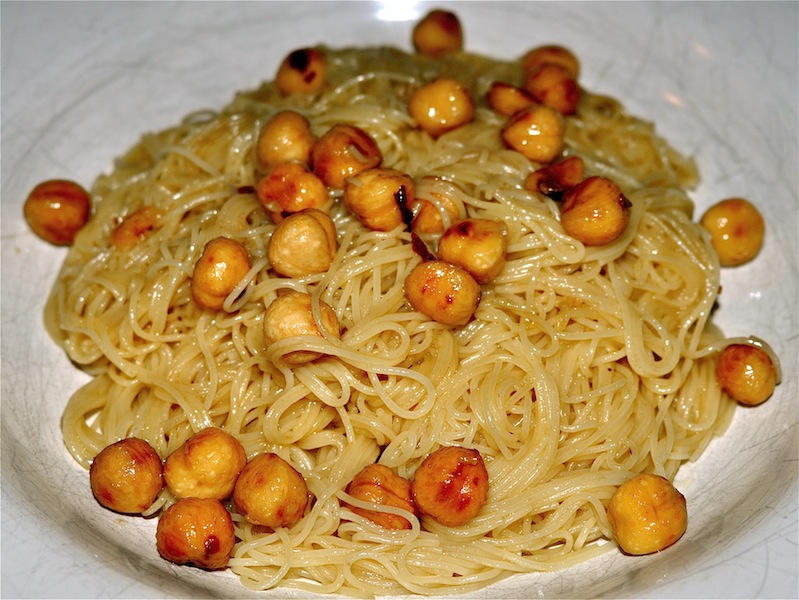
Pasta with garlic & hazelnuts


I just couldn't not think about Christmas. Last night, I mean. As I was cooking this stuff.

See, nine out of ten times Aunt Rita serves a version of this pasta to start off our big family meal on Christmas Eve. That would be right after we've plowed through a couple trays of Anna's baked clams, of course.


First thing to do is lightly toast the hazelnuts, either in a pan (as shown) or on a baking sheet in the oven. This is around two-thirds of a cup of nuts and it took less than five minutes to toast them. Then set them aside for later.


Saute a couple good-sized garlic cloves and a little crushed hot pepper in extra virgin olive oil.


Okay, you can consider this next step optional. Those are anchovy fillets I've added, but I know a lot of you don't go for that and so skip this step if you want. (I'd up the amount of garlic, though.)


Add the hazelnuts and turn up the heat to high. (I've left the nuts whole here but you can lightly crush them too if you like.)


Add your pasta of choice (angel hair here) and enough of the pasta water (be sure to save a couple cups) to keep things moist. This is around a half pound of pasta and I used a good half cup of the pasta water. (About the water: It's a pretty important ingredient in this dish, so make sure that it's very well salted.)


And there you go. Christmas in May.


Aunt Rita would've liked this version, I'm pretty sure.

Sunday, May 26, 2013

Grilled eggplant caponata


It being a holiday weekend I'm figuring the outdoor grills are getting a good workout. This may not look like something that can cook next to the burgers and the sausages but just be patient, all right.


What you do is throw some whole eggplant on the grill, along with a cut red onion and a head of garlic wrapped in foil.


When the eggplant is cooked through peel off the skin, shred the flesh and put it in a colander to allow the moisture to run out (weight it with something heavy and it'll dry out faster). Then chop the onion and remove the cooked garlic flesh from the skins.


Saute some celery and pine nuts in olive oil for a couple minutes, then quickly add a chopped tomato and some drained capers for another minute (not shown). In a bowl add the contents of the pan to the eggplant, onion and garlic, toss with some extra virgin olive oil, a little balsamic vinegar and salt and pepper to taste.


Not exactly a traditional Memorial Day snack, but it works just fine. For me.

Have a good holiday everybody!

Monday, May 20, 2013

Time to plant the tomatoes


Nobody asked me but... I decided to throw a couple cents into this season's tomato-planting discussion. (Whaddaya mean, you weren't discussing it! You have looked at a calendar, yes?)

My best advice on getting tomatoes started is this:


Buy plants that are around a foot tall and that have plenty of suckers growing from the lower portion. This one is around 11 inches, and has plenty of leaves and suckers throughout the entire plant.


Why is that so important? Because the first thing I'm going to urge you to do is cut off all that beautiful growth, about halfway up the stem, in fact.


Then dig a deep enough hole to bury the stem to the first sucker that's left.

Yes, your plants will look pretty scrawny compared to when you bought them at the garden center. But your odds of having a more productive plant just got a ton better than had you dropped the plant into the ground as-is. What's happening here is that all those areas where you pruned will develop into a more substantial root system for the plant, which makes it stronger and, in turn, able to produce better fruit.

One other thing: Tomato plants don't require frequent watering, so unless you live in a dry climate, try and leave the things alone until they need moisture. Under normal conditions I only water my tomato plants (20 or 30 of them, and all different varieties) a couple times a week.

I'll shut up now.

Wednesday, May 8, 2013

Mom's left hand


All women become like their mothers. That is their tragedy. No man does. That's his.
— Oscar Wilde

I wouldn't put this one in the bank.

Because long ago, and in a most important way, I became exactly like my own mother. The woman belonged in her kitchen. She was happiest when preparing tradition-rich foods for the people she loved, and most contented when with them at her three-leaf dining table as they ate and drank and gabbed and laughed and sometimes, yes, even cried.

Sound familiar?

I am especially like my mother in the important business of making meatballs. This is a woman so known for her cooking that, two days before leaving for an audience with Pope John Paul II in Rome, no less a person than my trusted associate thought to ask mom if she had planned on bringing the Holy Father a batch of her meatballs. (For the record, she was planning no such thing. "I'm on vacation," she said. "Besides, he has his own cook. Doesn't he?")

My mother and I did not share the same recipe for meatballs (hard to believe, I know) but the seriousness with which I approach the process (seen here) is a very deliberate nod to the woman who reared me.

"Nobody made meatballs like Aunt Mary," my cousin John has said of my mother thousands of times. "I'd give a lot to have just one more Sunday that had her in it — and her meatballs."

It has been alleged — though never by mom — that the secret lay not in a recipe but in her left hand.

"Your mother wasn't a lefty but she was when she made her meatballs," Aunt Laura has told me. "That's why nobody could ever duplicate them; we were all right-handed. You could follow her recipe to the letter but if you weren't able to comfortably form the balls in your left hand it didn't work."

Mom's sister Anna, also a fine maker of meatballs, tells me that many of the women in our family, as well as others outside of it, often studied alongside my mother trying to mirror both her recipe and her technique. To no avail.

"You want a better explanation than the left hand? Well, I don't have one," Aunt Anna tells me. "What do you want from me? My sister had her own way. She always did."

Should you study the details of my own meatball recipe (principally veal whereas mom's was mostly beef) you will see no mention of a left hand, my mother's or mine. That is because a parent's job is to encourage their children to cut their own path, and in this regard my mother must be judged a success.

Still, confident as I might be in my own kitchen, I stand firmly alongside cousin John here:

This coming Sunday, Mother's Day as it happens, would be a whole lot better if mom and her meatballs were around.

Wednesday, April 24, 2013

Good men and their sausage


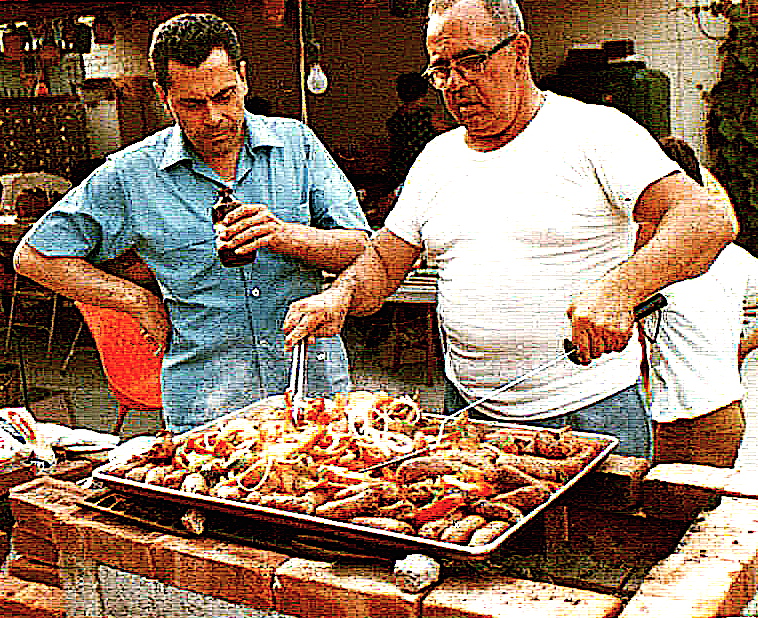
You can't see it here but the stamp on the back of this old photograph reads "July 1969."

A lot happened that month. Apollo 11 astronauts Neil Armstrong and Buzz Aldrin walked on the moon and the first U.S. troops left Vietnam. New York Mets ace Tom Seaver lost his bid for a no hitter with only two outs left in the ninth. Brian Jones, the original leader of The Rolling Stones, drowned in his swimming pool. And, in a tragedy that would haunt him the rest of his days, Ted Kennedy pleaded guilty to leaving the scene of a car accident on Chappaquiddick Island in Massachusetts, an accident where a young woman named Mary Jo Kopechne had died.

Very early that month, July 4th to be precise, something a bit less noteworthy occurred: I learned that if ever I was to grow up and become a man I would need to learn how to build a fire, drink a cold beer, and cook an enormous amount of sausage, peppers and onions for the people I love.

Please don't ask me why. It's just what we're supposed to do. And you know it.

I could look at this picture a thousand more times and every time the tastes inside my head will be the same. Not a red pepper or garlic clove or onion slice or fennel seed's bit of difference.

It's the way I like it. The same. Every time.

Uncle Joe does the cooking because it is his backyard, his makeshift brick-and-cinder block fire pit, and his party. Uncle Dominic consults with his brother and drinks his cold beer. The rest of the family, thirty of us perhaps, wait for my uncles to announce that it's time to eat.

Somewhere nearby I am watching and learning.

Summer is coming. Time to man up.

Tuesday, April 16, 2013

Bubbles make great pizza


The last great pizza I had was at Brooklyn Central, a new Neapolitan-style joint in my old neighborhood. We're talking thin crust wood-fired pizza here. With just the right amount of char and, equally important to me, lots of beautiful bubbles.

"You like these?" I said pointing to one of the three pies on the table, the Margherita I believe. "The bubbles I mean. You think they're a good thing?"

I was speaking to my friends Tom and Beth, fine pizzaioli in their own right and regular customers of the place where we were eating. Tom, the verbose member of the pair, spent the rest of the pie-eating session advocating the bubbles-on-pizza theory.

Not only that, but he actually knew what he was yammering about. Clearly my friend had studied this crucial topic, so much so that I asked him to share his knowledge with all of us here.

Take it away, genius.

The bubble theory
by Tom Strenk

Bubbles are a sign of great pizza, but they're more than that. Bubbles give baked goods their tender character, from the delicate sponge of a chocolate layer cake to the flaky layers of a croissant. Depending upon the baked good, the bubbles come from carbon dioxide created by leavening such as baking powder used in cakes or butter folded into puff pastry dough. Pizza gets some of its bubbles from yeast, a beneficial microorganism that converts fermentable sugars in the dough into carbon dioxide.

But the bubbles our friend Meatball was so fixated on at Brooklyn Central derived from a different source: steam. When vaporized, water expands over 1,600 times in volume, according to Paula Figoni, writing in her book, How Baking Works. For this phenomenon to work, though, the dough has to be wet, soft and loose, and the oven must be super hot.

That's exactly the conditions called for by the Associazione Verace Pizza Napoletana, a group dedicated to preserving the Neopolitan pizza tradition. AVPN sets forth the exacting principles governing the one true pizza, and its regulations are many and persnickety. Dough can only be made from ultra-soft double-zero flour, with 1 liter of water to 1.8 kg. of flour ration, with the flour absorbing 50-55% of its weight in water. That translates into a wet, almost sticky dough, with a soft and elastic texture, says the AVPN. Ovens must be hotter than Dante's Inferno, with a minimum floor temperature of 905 degrees, and a cavity temp of 800 or more degrees; the pizza cooks fast, in 60-90 seconds.

When the pizzaiolo slides that pie (14 inches in diameter, 0.8-inch thick crust, 0.1-inch thick in the center) into the oven, water in the mix vaporizes, the wet glutinous dough is flexible enough to stretch and contain the vapor, then the extreme heat dries and chars the bubbles. The end result: a delicate, light and airy crust.

I got to experience this magic hands-on at Forcella, a New York restaurant devoted to Neapolitan pizza. Under the tutelage of certified pizza master Giulio Adrian, I learned to properly handle the demanding dough, shaping a certifiable crust, topping the classic Margherita with San Marzano tomatoes, mozzarella di Bufala, fresh basil leaves and a drizzle of extra-virgin olive oil, and baking it in Forcella's imported Italian oven. I'm sure the AVPN would approve.


Even better, when that blistered, bubbled pie was whisked out on a peel, I got to eat it.